





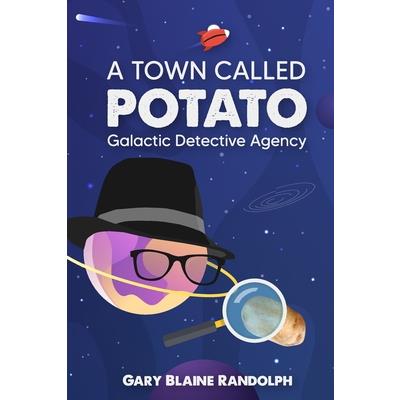
A Town Called Potato
A Town Called PotatoATown Called PotatoA Space Noir Murder Comedy




活動訊息
普發一萬放大術:滿千登記抽萬元好禮

全站滿$1000送100點金幣,可累送! 新會員直接領$500!

內容簡介
It's a lighthearted murder mystery ... with space aliens! Gabriel Lake is a not so hard-boiled computer guy who finds himself swept up into a web of interstellar crime when he is recruited into the Galactic Detective Agency, led by the brilliant Oren Vilkas. Can a mere Earthling track a killer across the stars before more lives are lost? Can he negotiate his way around other worlds and understand the ways of extra-terrestrial cultures? Can he even figure out how to use a bathroom designed for aliens? And can he uncover the mystery of A Town Called Potato? INTERVIEW WITH THE AUTHOR Q. How did you come up with the title A Town Called Potato?
A. I didn't. It was a random thing one of my grandsons said at eight years old one day while we were playing. I often keep track of funny things my grandkids say, but this one really stuck with me. I kept thinking about that town and why it might be called Potato. I already knew I wanted to write a comedy sci-fi story, and the title just seemed to fit. The book evolved from that, and I named the protagonist after my grandson. Q. What authors inspired you in writing A Town Called Potato?
A. Given that the story is a mash-up of comedy sci-fi and detective fiction, authors from each of those genres inspired me. In detective fiction, I love Rex Stout's Nero Wolfe books. In fact, it isn't too hard to see that Oren Vilkas is a homage to Nero Wolfe. And it was Rex Stout, along with Sue Grafton and Arthur Conan Doyle, who inspired me to write the book in first person. Of course when you think of comedic sci-fi, Douglas Adams is the king, and I have tried to capture a fraction of his sense of imaginative. Terry Pratchett is another comedic writer who has always inspired me with his brilliance. And I have to mention P. G. Wodehouse the OG of character-driven comedy novels. Q. Did you find it difficult to mash up so many genres?
A. I did at first. I kept veering off just into comedy or just into detective noir. So it needed a few passes through the text to make sure I got all the boxes ticked and to get into the swing of things. I wanted Gabriel Lake to be so infused with detective fiction that his inner monologue just naturally takes on the cadences of film noir. The trick was to make that comedic and not just cheap parody. I think I found the balance by making Gabriel self-effacing in describing his fish-out-of-water adventures in space and in bringing everyone else in on the joke as well. By the end I found it easier to find Gabe's voice, and as I got into the sequel, The Maltese Salmon, it started feeling more and more like home. Q. Where did you get the idea for the chrono engine?
A. Every sci-fi novel that deals with interstellar travel has to deal with how to cross the mind-boggling vast expanses of space. You can devise some kind of faster-than-light travel (warp drive, hyperspace, etc.), or hypothesize traversable wormholes, or imagine a constant acceleration drive that achieves some significant fraction of light-speed, or have generation/sleeper ships. But I was shooting for comedy sci-fi. I knew I needed some preposterous tongue-in-cheek technology, something Douglas Adams might come up with. So I thought for a long time about "What Would Doug Do?" My answer with the chrono engine weaves together a wee bit of hard science (the fact that the universe used to be mush smaller) with the most outrageous hand-waving technobabble that I could come up with. I hope it makes you chuckle.
A. I didn't. It was a random thing one of my grandsons said at eight years old one day while we were playing. I often keep track of funny things my grandkids say, but this one really stuck with me. I kept thinking about that town and why it might be called Potato. I already knew I wanted to write a comedy sci-fi story, and the title just seemed to fit. The book evolved from that, and I named the protagonist after my grandson. Q. What authors inspired you in writing A Town Called Potato?
A. Given that the story is a mash-up of comedy sci-fi and detective fiction, authors from each of those genres inspired me. In detective fiction, I love Rex Stout's Nero Wolfe books. In fact, it isn't too hard to see that Oren Vilkas is a homage to Nero Wolfe. And it was Rex Stout, along with Sue Grafton and Arthur Conan Doyle, who inspired me to write the book in first person. Of course when you think of comedic sci-fi, Douglas Adams is the king, and I have tried to capture a fraction of his sense of imaginative. Terry Pratchett is another comedic writer who has always inspired me with his brilliance. And I have to mention P. G. Wodehouse the OG of character-driven comedy novels. Q. Did you find it difficult to mash up so many genres?
A. I did at first. I kept veering off just into comedy or just into detective noir. So it needed a few passes through the text to make sure I got all the boxes ticked and to get into the swing of things. I wanted Gabriel Lake to be so infused with detective fiction that his inner monologue just naturally takes on the cadences of film noir. The trick was to make that comedic and not just cheap parody. I think I found the balance by making Gabriel self-effacing in describing his fish-out-of-water adventures in space and in bringing everyone else in on the joke as well. By the end I found it easier to find Gabe's voice, and as I got into the sequel, The Maltese Salmon, it started feeling more and more like home. Q. Where did you get the idea for the chrono engine?
A. Every sci-fi novel that deals with interstellar travel has to deal with how to cross the mind-boggling vast expanses of space. You can devise some kind of faster-than-light travel (warp drive, hyperspace, etc.), or hypothesize traversable wormholes, or imagine a constant acceleration drive that achieves some significant fraction of light-speed, or have generation/sleeper ships. But I was shooting for comedy sci-fi. I knew I needed some preposterous tongue-in-cheek technology, something Douglas Adams might come up with. So I thought for a long time about "What Would Doug Do?" My answer with the chrono engine weaves together a wee bit of hard science (the fact that the universe used to be mush smaller) with the most outrageous hand-waving technobabble that I could come up with. I hope it makes you chuckle.
配送方式
-
台灣
- 國內宅配:本島、離島
-
到店取貨:
 不限金額免運費



-
海外
- 國際快遞:全球
-
港澳店取:


訂購/退換貨須知
加入金石堂 LINE 官方帳號『完成綁定』,隨時掌握出貨動態:


商品運送說明:
- 本公司所提供的產品配送區域範圍目前僅限台灣本島。注意!收件地址請勿為郵政信箱。
- 商品將由廠商透過貨運或是郵局寄送。消費者訂購之商品若無法送達,經電話或 E-mail無法聯繫逾三天者,本公司將取消該筆訂單,並且全額退款。
- 當廠商出貨後,您會收到E-mail出貨通知,您也可透過【訂單查詢】確認出貨情況。
- 產品顏色可能會因網頁呈現與拍攝關係產生色差,圖片僅供參考,商品依實際供貨樣式為準。
- 如果是大型商品(如:傢俱、床墊、家電、運動器材等)及需安裝商品,請依商品頁面說明為主。訂單完成收款確認後,出貨廠商將會和您聯繫確認相關配送等細節。
- 偏遠地區、樓層費及其它加價費用,皆由廠商於約定配送時一併告知,廠商將保留出貨與否的權利。
提醒您!!
金石堂及銀行均不會請您操作ATM! 如接獲電話要求您前往ATM提款機,請不要聽從指示,以免受騙上當!
退換貨須知:
**提醒您,鑑賞期不等於試用期,退回商品須為全新狀態**
-
依據「消費者保護法」第19條及行政院消費者保護處公告之「通訊交易解除權合理例外情事適用準則」,以下商品購買後,除商品本身有瑕疵外,將不提供7天的猶豫期:
- 易於腐敗、保存期限較短或解約時即將逾期。(如:生鮮食品)
- 依消費者要求所為之客製化給付。(客製化商品)
- 報紙、期刊或雜誌。(含MOOK、外文雜誌)
- 經消費者拆封之影音商品或電腦軟體。
- 非以有形媒介提供之數位內容或一經提供即為完成之線上服務,經消費者事先同意始提供。(如:電子書、電子雜誌、下載版軟體、虛擬商品…等)
- 已拆封之個人衛生用品。(如:內衣褲、刮鬍刀、除毛刀…等)
- 若非上列種類商品,均享有到貨7天的猶豫期(含例假日)。
- 辦理退換貨時,商品(組合商品恕無法接受單獨退貨)必須是您收到商品時的原始狀態(包含商品本體、配件、贈品、保證書、所有附隨資料文件及原廠內外包裝…等),請勿直接使用原廠包裝寄送,或於原廠包裝上黏貼紙張或書寫文字。
- 退回商品若無法回復原狀,將請您負擔回復原狀所需費用,嚴重時將影響您的退貨權益。


商品評價