





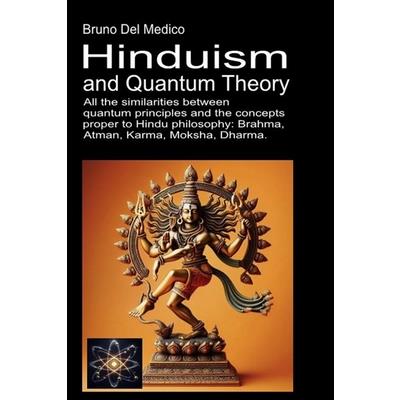
Hinduism and Quantum Theory


-
9折 957元
1064元
-
 預計最高可得金幣45點
?
可100%折抵
預計最高可得金幣45點
?
可100%折抵
活動加倍另計 -
HAPPY GO享100累1點 4點抵1元 折抵無上限
-
分類:英文書>自然科普>自然科學>光學追蹤? 追蹤分類後,您會在第一時間收到分類新品通知。
- 作者: Bruno,del Medico 追蹤 ? 追蹤作者後,您會在第一時間收到作者新書通知。
- 出版社: Pensarediverso-Ing 追蹤 ? 追蹤出版社後,您會在第一時間收到出版社新書通知。
- 出版日:2026/01/08

活動訊息
中文書、漫畫輕小說5折起、電子書35元起,全館滿$1,000送100點金幣

內容簡介
Comparing Eastern philosophies and quantum physics reveals fascinating similarities that invite us to reconsider our understanding of reality.
The intent of the book is to explore the surprising connection between the ancient philosophical traditions of Hinduism and the principles of quantum physics. An initial part explains in a totally understandable way the basic principles of quantum physics and the philosophy related to this new science. In the sequel, an evocative journey, leads the reader to discover how these two seemingly distant realities can interact and influence each other.
Hinduism, with its profound metaphysical principles, offers a framework that seems to anticipate in many respects the discoveries of quantum physics. The book compares some of the major themes of Hinduism with their corresponding quantum notions.
Brahman represents ultimate reality, an interconnected whole that permeates everything. This aligns with the concept of quantum entanglement, in which particles can remain connected regardless of the distance between them, and suggests that separation at the fundamental level may just be an illusion. One of the Upanishads reads, "All this is Brahman," highlighting universal interconnectedness, and recalls the Higgs field, which gives mass and wave nature to particles.
Atman, the individual soul that is a manifestation of Brahman, can be viewed through the lens of quantum superposition, in which one particle exists in multiple states simultaneously. This reflects the idea that the true essence of the self exists on multiple planes of reality.
The concept of Karma is based on the law of cause and effect, parallel to Heisenberg's indeterminacy, where the precision of one measure affects that of another. Actions in the present can thus influence future outcomes in ways that are not always predictable.
Moksha, liberation from the cycle of death and rebirth, finds a parallel in quantum decoherence, the process by which a quantum system loses its quantum properties. This transition represents the transformation of consciousness from one state to another, analogous to the quest for spiritual liberation.
Dharma, or each person's ethical duty, is reflected in correlations between particles, where interactions influence the behavior of a complex system. Any action taken in accordance with Dharma can have long-term effects; similarly, quantum relationships shape our universe.
It should be pointed out that this book deals with Hindu philosophy, not Hindu religion.
This distinction takes on particular relevance in the context of quantum physics. While Hindu religion deals with devotion and the cosmic order established by deities, Hindu philosophy offers a framework for understanding a complex, interconnected and constantly changing reality. For example, the idea of Maya-the illusory perception of the material world-has parallels with the uncertainty principle in quantum physics, according to which we cannot simultaneously know precisely the position and velocity of a particle.
Finally, religion is a collective and ritual path, while philosophy is a more individual and contemplative path. Both enrich Hinduism, but with different perspectives and goals. In religion one seeks union with the divine. In philosophy one seeks an understanding of being. The two dimensions, therefore, coexist but offer different tools for exploring the same reality. As Swami Vivekananda told the World Parliament of Religions in 1893, "Hinduism is not a religion, but an infinite wealth of human experience." A phrase that perfectly sums up this richness and complexity.
配送方式
-
台灣
- 國內宅配:本島、離島
-
到店取貨:
 不限金額免運費



-
海外
- 國際快遞:全球
-
港澳店取:


訂購/退換貨須知
加入金石堂 LINE 官方帳號『完成綁定』,隨時掌握出貨動態:


商品運送說明:
- 本公司所提供的產品配送區域範圍目前僅限台灣本島。注意!收件地址請勿為郵政信箱。
- 商品將由廠商透過貨運或是郵局寄送。消費者訂購之商品若無法送達,經電話或 E-mail無法聯繫逾三天者,本公司將取消該筆訂單,並且全額退款。
- 當廠商出貨後,您會收到E-mail出貨通知,您也可透過【訂單查詢】確認出貨情況。
- 產品顏色可能會因網頁呈現與拍攝關係產生色差,圖片僅供參考,商品依實際供貨樣式為準。
- 如果是大型商品(如:傢俱、床墊、家電、運動器材等)及需安裝商品,請依商品頁面說明為主。訂單完成收款確認後,出貨廠商將會和您聯繫確認相關配送等細節。
- 偏遠地區、樓層費及其它加價費用,皆由廠商於約定配送時一併告知,廠商將保留出貨與否的權利。
提醒您!!
金石堂及銀行均不會請您操作ATM! 如接獲電話要求您前往ATM提款機,請不要聽從指示,以免受騙上當!
退換貨須知:
**提醒您,鑑賞期不等於試用期,退回商品須為全新狀態**
-
依據「消費者保護法」第19條及行政院消費者保護處公告之「通訊交易解除權合理例外情事適用準則」,以下商品購買後,除商品本身有瑕疵外,將不提供7天的猶豫期:
- 易於腐敗、保存期限較短或解約時即將逾期。(如:生鮮食品)
- 依消費者要求所為之客製化給付。(客製化商品)
- 報紙、期刊或雜誌。(含MOOK、外文雜誌)
- 經消費者拆封之影音商品或電腦軟體。
- 非以有形媒介提供之數位內容或一經提供即為完成之線上服務,經消費者事先同意始提供。(如:電子書、電子雜誌、下載版軟體、虛擬商品…等)
- 已拆封之個人衛生用品。(如:內衣褲、刮鬍刀、除毛刀…等)
- 若非上列種類商品,均享有到貨7天的猶豫期(含例假日)。
- 辦理退換貨時,商品(組合商品恕無法接受單獨退貨)必須是您收到商品時的原始狀態(包含商品本體、配件、贈品、保證書、所有附隨資料文件及原廠內外包裝…等),請勿直接使用原廠包裝寄送,或於原廠包裝上黏貼紙張或書寫文字。
- 退回商品若無法回復原狀,將請您負擔回復原狀所需費用,嚴重時將影響您的退貨權益。



商品評價