




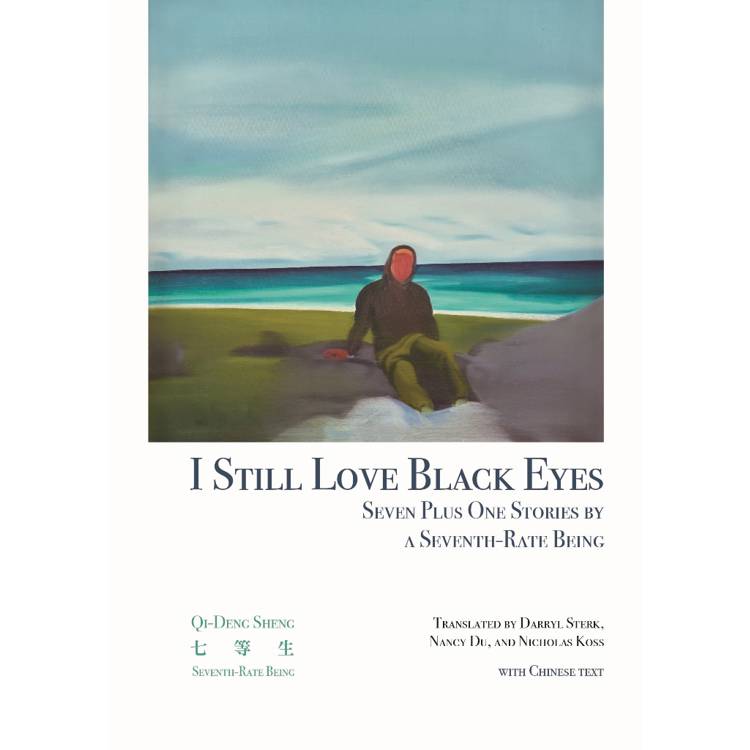
I Still Love Black Eyes: Seven Plus One Stories by a Seventh-Rate Being
我愛黑眼珠




活動訊息
中文書、漫畫輕小說5折起、電子書35元起,全館滿$1,000送100點金幣

內容簡介
Behold the stars above, bear witness to their infinitesimal yet penetrating radiance, and know this: that we are not the last of us.
For me, writing records the world and conserves memory; I write in order to sieve myself out from the muddle of the world, or wrest myself away from the crowd. My pen name is a form of protest against people who practically herd themselves towards some or another empty value or false worth.
—Qi-Deng Sheng, or Seventh-Rate Being
Qi-Deng Sheng was one of the most philosophically incisive creative writers on the Taiwan island in the 1960s and 70s, and one of the most controversial figures in local literary history. Criticism of his work is polarized, in a sort of tug of war between “collective consciousness” and “individual will” in the cultural landscape of a rapidly modernizing society.
As the hive mind buzzed, Qi-Deng Sheng tuned out and listened to his inner voice. As he explains in the above quotation, he regarded writing as a creative process that differentiated the ego from the group, and reality from falsehood. In other words, he wrote to build a sanctuary for his individuality. On the one hand, he was committed to conveying his personal beliefs through his works, rejecting vulgarity wherever he found it: in social groups, cultural trends, even literary critics. On the other hand, he was dedicated to highlighting the antagonism between self and society––to spotlighting the poor, deprived, embattled, isolated ego who was trying to strike a balance between being unique and understood.
The voices of protest in Qi-Deng Sheng’s stories belong to bit players such as Jaspers or Li Lung-ti. “Outsiders” like them are sensitive to the nuances of interpersonal interaction but remain steadfast in their beliefs. Through repeated exits and entries, between country and town, they decide where to settle down. In all their choices, they experience the conflict and struggle of them vs. me, how the world seems to me and what it actually might be. Qi-Deng Sheng regarded the girl with “black eyes” in “I Love Black Eyes” as his “ideal lover/goddess,” and she became his wisdom eye; he entrusted her with the task of guide. As he pursued an authentic life, she showed him true beauty; she kept him passionate, and encouraged him to keep fighting for spiritual freedom.
Reading Qi-Deng Sheng’s fiction is like plucking a string kept under tension by two opposing yet complementary forces: “the monad’s defiance of the group” and “the gonad’s alliance with the goddess.” These forces can be understood in terms of polyphony, as two themes that are harmonious yet dissonant, contradictory yet consistent—as twin motifs that lend profoundly lyrical colors to his oeuvre, demonstrating his inimitable value in the history of modern Taiwan literature.
“I wish you were dead, Tsing-tzu,” he thought. “I wish you’d been washed away by the water or trampled to death by the crowd. I will stand by my beliefs and wait for circumstances to change. Were I to sit in stonelike silence like a helpless pessimist or indulge in the mocking laughter of a heartless optimist, gleeful to see the world in peril, then I would be deprived of my existence.”
—“I love black eyes”
“From then on, whenever he came to Cold Lane, music never failed to trickle out of the cracks in the walls (like the light that glowed in that window). He went there every night, until one day he didn’t, the day his fellow city dwellers realized he’d disappeared. The suitcase was still there at the inn. ”
—“The long-jumper retires”
For me, writing records the world and conserves memory; I write in order to sieve myself out from the muddle of the world, or wrest myself away from the crowd. My pen name is a form of protest against people who practically herd themselves towards some or another empty value or false worth.
—Qi-Deng Sheng, or Seventh-Rate Being
Qi-Deng Sheng was one of the most philosophically incisive creative writers on the Taiwan island in the 1960s and 70s, and one of the most controversial figures in local literary history. Criticism of his work is polarized, in a sort of tug of war between “collective consciousness” and “individual will” in the cultural landscape of a rapidly modernizing society.
As the hive mind buzzed, Qi-Deng Sheng tuned out and listened to his inner voice. As he explains in the above quotation, he regarded writing as a creative process that differentiated the ego from the group, and reality from falsehood. In other words, he wrote to build a sanctuary for his individuality. On the one hand, he was committed to conveying his personal beliefs through his works, rejecting vulgarity wherever he found it: in social groups, cultural trends, even literary critics. On the other hand, he was dedicated to highlighting the antagonism between self and society––to spotlighting the poor, deprived, embattled, isolated ego who was trying to strike a balance between being unique and understood.
The voices of protest in Qi-Deng Sheng’s stories belong to bit players such as Jaspers or Li Lung-ti. “Outsiders” like them are sensitive to the nuances of interpersonal interaction but remain steadfast in their beliefs. Through repeated exits and entries, between country and town, they decide where to settle down. In all their choices, they experience the conflict and struggle of them vs. me, how the world seems to me and what it actually might be. Qi-Deng Sheng regarded the girl with “black eyes” in “I Love Black Eyes” as his “ideal lover/goddess,” and she became his wisdom eye; he entrusted her with the task of guide. As he pursued an authentic life, she showed him true beauty; she kept him passionate, and encouraged him to keep fighting for spiritual freedom.
Reading Qi-Deng Sheng’s fiction is like plucking a string kept under tension by two opposing yet complementary forces: “the monad’s defiance of the group” and “the gonad’s alliance with the goddess.” These forces can be understood in terms of polyphony, as two themes that are harmonious yet dissonant, contradictory yet consistent—as twin motifs that lend profoundly lyrical colors to his oeuvre, demonstrating his inimitable value in the history of modern Taiwan literature.
“I wish you were dead, Tsing-tzu,” he thought. “I wish you’d been washed away by the water or trampled to death by the crowd. I will stand by my beliefs and wait for circumstances to change. Were I to sit in stonelike silence like a helpless pessimist or indulge in the mocking laughter of a heartless optimist, gleeful to see the world in peril, then I would be deprived of my existence.”
—“I love black eyes”
“From then on, whenever he came to Cold Lane, music never failed to trickle out of the cracks in the walls (like the light that glowed in that window). He went there every night, until one day he didn’t, the day his fellow city dwellers realized he’d disappeared. The suitcase was still there at the inn. ”
—“The long-jumper retires”
配送方式
-
台灣
- 國內宅配:本島、離島
-
到店取貨:
 不限金額免運費



-
海外
- 國際快遞:全球
-
港澳店取:


訂購/退換貨須知
加入金石堂 LINE 官方帳號『完成綁定』,隨時掌握出貨動態:


商品運送說明:
- 本公司所提供的產品配送區域範圍目前僅限台灣本島。注意!收件地址請勿為郵政信箱。
- 商品將由廠商透過貨運或是郵局寄送。消費者訂購之商品若無法送達,經電話或 E-mail無法聯繫逾三天者,本公司將取消該筆訂單,並且全額退款。
- 當廠商出貨後,您會收到E-mail出貨通知,您也可透過【訂單查詢】確認出貨情況。
- 產品顏色可能會因網頁呈現與拍攝關係產生色差,圖片僅供參考,商品依實際供貨樣式為準。
- 如果是大型商品(如:傢俱、床墊、家電、運動器材等)及需安裝商品,請依商品頁面說明為主。訂單完成收款確認後,出貨廠商將會和您聯繫確認相關配送等細節。
- 偏遠地區、樓層費及其它加價費用,皆由廠商於約定配送時一併告知,廠商將保留出貨與否的權利。
提醒您!!
金石堂及銀行均不會請您操作ATM! 如接獲電話要求您前往ATM提款機,請不要聽從指示,以免受騙上當!
退換貨須知:
**提醒您,鑑賞期不等於試用期,退回商品須為全新狀態**
-
依據「消費者保護法」第19條及行政院消費者保護處公告之「通訊交易解除權合理例外情事適用準則」,以下商品購買後,除商品本身有瑕疵外,將不提供7天的猶豫期:
- 易於腐敗、保存期限較短或解約時即將逾期。(如:生鮮食品)
- 依消費者要求所為之客製化給付。(客製化商品)
- 報紙、期刊或雜誌。(含MOOK、外文雜誌)
- 經消費者拆封之影音商品或電腦軟體。
- 非以有形媒介提供之數位內容或一經提供即為完成之線上服務,經消費者事先同意始提供。(如:電子書、電子雜誌、下載版軟體、虛擬商品…等)
- 已拆封之個人衛生用品。(如:內衣褲、刮鬍刀、除毛刀…等)
- 若非上列種類商品,均享有到貨7天的猶豫期(含例假日)。
- 辦理退換貨時,商品(組合商品恕無法接受單獨退貨)必須是您收到商品時的原始狀態(包含商品本體、配件、贈品、保證書、所有附隨資料文件及原廠內外包裝…等),請勿直接使用原廠包裝寄送,或於原廠包裝上黏貼紙張或書寫文字。
- 退回商品若無法回復原狀,將請您負擔回復原狀所需費用,嚴重時將影響您的退貨權益。


商品評價