




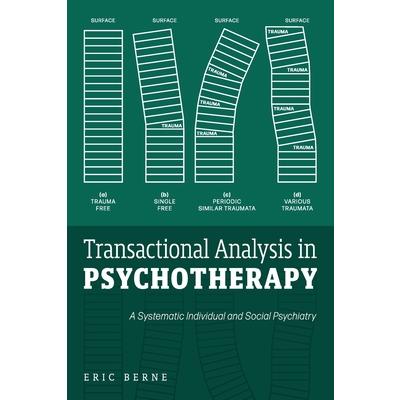
Transactional Analysis in Psychotherapy




活動訊息
中文書、漫畫輕小說5折起、電子書35元起,全館滿$1,000送100點金幣
內容簡介
Reprint of original 1961 edition.
Transactional Analysis in Psychotherapy by Eric Berne, M.D. introduced psychiatrists and analysts to a new way of understanding the motivations and social interactions of their clients and patients. By using this model, Berne believed that therapists could help their patients to better understand themselves and improve their relationships and their lives.
Canadian-born psychiatrist Eric Berne (b. May 10, 1910 - d. July 15, 1970) spent his early career working with patients in sanitariums before serving as a psychiatrist in the U.S. Army during World War II. After the war, he set up a private practice, in addition to conducting his own research and serving as a psychiatrist at the Veterans Administration and Mental Hygiene Clinic in San Francisco.
After being denied admittance to the San Francisco Psychoanalytic Institute in 1956, Berne was spurred to make his own mark on the field. He wrote several papers that year as he developed his theories, and he was invited to present his article "Transactional Analysis: A New and Effective Group Therapy" to the Western Regional Meeting of the American Group Psychotherapy Association of Los Angeles in 1957.
The next step was to put these ideas down into a book - 1961's Transactional Analysis in Psychotherapy. Berne's theory, while built on a foundation of Freudian principles, was clearly different. Where Freudian psychoanalysts focused on the balance between the emotional id, rational ego, and moral superego that make up one's personality, Berne instead assigned interpersonal relationships to the three ego-states of his clients - the Parent, Adult, and Child inside each.
The way we interact with each other, Berne proposed, influences which of our three ego-states is prominent at any given time. Transactional Analysis in Psychotherapy begins by identifying these ego-states and explaining how to diagnose them. It then explores the way social intercourse (called transactions) can stimulate the different ego-states.
Common social interactions are described in the language of games - different predictable patterns of communication that may appear normal on the surface, but conceal tension and self-serving - or self-destructive - motives beneath. Often counterproductive, these games indulge one of our ego-states and can damage our mental well-being and relationships.
An example of a game is called, "Why Don't You...Yes, But." In this game, one person makes suggestions in order to solve a person's problem, and the other rejects each with a "Yes, but..." type statement. Instead of an Adult-Adult interaction, with one offering reasoned suggestions and the other engaging in a meaningful dialogue, the suggester takes on a Parental role of problem-solver, and the other that of an attention-seeking Child who wants reassurance, not a solution.
One of the most important aspects of transactional analysis is the contract. This tool is an agreement made by both client and therapist that the client will work on specific changes to achieve their desired outcome.
Although some in the psychoanalytic community ignored Berne's work, many therapists used his ideas with their own clients. His later works include A Layman's Guide to Psychiatry and Psychoanalysis, Games People Play, and What Do You Say After You Say Hello?, published in 1975 after Berne's death.
Berne's development of transactional analysis was a major influence on Thomas Harris's 1967 New York Times bestseller I'm OK - You're OK, which introduced many laypeople to the concept of the Parent-Adult-Child model.
配送方式
-
台灣
- 國內宅配:本島、離島
-
到店取貨:
 不限金額免運費



-
海外
- 國際快遞:全球
-
港澳店取:


訂購/退換貨須知
加入金石堂 LINE 官方帳號『完成綁定』,隨時掌握出貨動態:


商品運送說明:
- 本公司所提供的產品配送區域範圍目前僅限台灣本島。注意!收件地址請勿為郵政信箱。
- 商品將由廠商透過貨運或是郵局寄送。消費者訂購之商品若無法送達,經電話或 E-mail無法聯繫逾三天者,本公司將取消該筆訂單,並且全額退款。
- 當廠商出貨後,您會收到E-mail出貨通知,您也可透過【訂單查詢】確認出貨情況。
- 產品顏色可能會因網頁呈現與拍攝關係產生色差,圖片僅供參考,商品依實際供貨樣式為準。
- 如果是大型商品(如:傢俱、床墊、家電、運動器材等)及需安裝商品,請依商品頁面說明為主。訂單完成收款確認後,出貨廠商將會和您聯繫確認相關配送等細節。
- 偏遠地區、樓層費及其它加價費用,皆由廠商於約定配送時一併告知,廠商將保留出貨與否的權利。
提醒您!!
金石堂及銀行均不會請您操作ATM! 如接獲電話要求您前往ATM提款機,請不要聽從指示,以免受騙上當!
退換貨須知:
**提醒您,鑑賞期不等於試用期,退回商品須為全新狀態**
-
依據「消費者保護法」第19條及行政院消費者保護處公告之「通訊交易解除權合理例外情事適用準則」,以下商品購買後,除商品本身有瑕疵外,將不提供7天的猶豫期:
- 易於腐敗、保存期限較短或解約時即將逾期。(如:生鮮食品)
- 依消費者要求所為之客製化給付。(客製化商品)
- 報紙、期刊或雜誌。(含MOOK、外文雜誌)
- 經消費者拆封之影音商品或電腦軟體。
- 非以有形媒介提供之數位內容或一經提供即為完成之線上服務,經消費者事先同意始提供。(如:電子書、電子雜誌、下載版軟體、虛擬商品…等)
- 已拆封之個人衛生用品。(如:內衣褲、刮鬍刀、除毛刀…等)
- 若非上列種類商品,均享有到貨7天的猶豫期(含例假日)。
- 辦理退換貨時,商品(組合商品恕無法接受單獨退貨)必須是您收到商品時的原始狀態(包含商品本體、配件、贈品、保證書、所有附隨資料文件及原廠內外包裝…等),請勿直接使用原廠包裝寄送,或於原廠包裝上黏貼紙張或書寫文字。
- 退回商品若無法回復原狀,將請您負擔回復原狀所需費用,嚴重時將影響您的退貨權益。


商品評價