




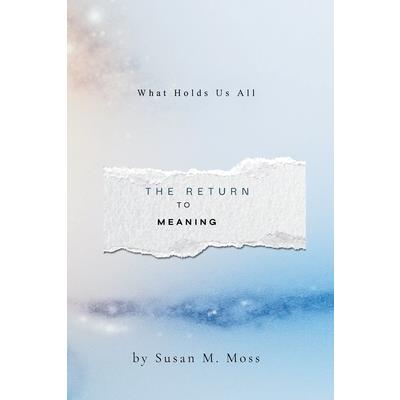
The Return to Meaning





活動訊息
全館滿$1,200送150點金幣,4月歡慶兒童節,童書、玩具、文具滿1000元再送200點金幣!

內容簡介
The Return to Meaning begins with a question that modern thought often circles without fully confronting: where does consciousness come from, and what must reality be like for experience to exist at all? Rather than treating awareness as a late and accidental by-product of biology, this book approaches consciousness as a problem of structure, continuity, and coherence. It asks whether experience emerges only after matter becomes complex, or whether the conditions that make consciousness possible are already implicit in the deepest architecture of reality itself.
Most contemporary accounts of consciousness move forward from the brain, tracing awareness upward from neurons, networks, and adaptive advantage. While these approaches have yielded important insights, they often leave an explanatory gap at the foundation. They describe how experience is processed and regulated, but not why a universe governed by physical law should give rise to experience in the first place. This book reverses the direction of inquiry. Instead of beginning with biology, it begins with coherence.
Drawing on psychology, physics, philosophy, and lived human experience, The Return to Meaning explores the possibility that consciousness is not an anomaly layered onto an otherwise indifferent universe, but a consequence of the same ordering principles that allow anything to persist over time. Long before atoms, stars, or life existed, reality already exhibited structure: patterns of relation, balance, and constraint that made continuity possible. Without coherence, nothing endures. Without endurance, nothing can be known. Without memory, no system can remain itself long enough to experience anything at all.
Within this framework, the emergence of mass through the Higgs field is treated not as the beginning of substance, but as one moment within a much deeper story about how form arises from underlying order. The Big Bang is approached not as an absolute beginning, but as a transition, a change of state within a reality that already possessed structure and constraint. Light, rather than being the first expression of existence, becomes one of the earliest measurable consequences of organising principles already at work beneath observable phenomena.
Consciousness, in this account, is neither reduced to a particle nor elevated to a mystical essence. Instead, it is understood as the capacity of a system to register, retain, and respond meaningfully to its own state. Experience arises where coherence, memory, and responsiveness intersect. As systems develop greater stability and internal integration, consciousness becomes increasingly articulated rather than suddenly appearing at a single threshold of complexity.
The implications of this view extend into psychology and ethics. Human identity is examined as a product of continuity across time, grounded in memory not merely as recall, but as the preservation of meaning. Psychological distress and fragmentation are explored as disruptions of coherence rather than simple pathologies. When continuity collapses, experience becomes unstable. When coherence is restored, meaning re-emerges. Ethically, the book argues that when consciousness is treated as secondary or illusory, human value becomes fragile. By contrast, when experience is understood as rooted in the same organising principles that sustain reality itself, responsibility and care arise not from sentiment, but from structure.
Written in a reflective but rigorous style, The Return to Meaning bridges scientific insight and philosophical depth without collapsing one into the other. It is intended for readers who sense that something essential has been lost in modern explanations of mind and matter, and who are willing to think carefully about what must be true for awareness, continuity, and meaning to exist at all.
配送方式
-
台灣
- 國內宅配:本島、離島
-
到店取貨:
 不限金額免運費



-
海外
- 國際快遞:全球
-
港澳店取:


訂購/退換貨須知
加入金石堂 LINE 官方帳號『完成綁定』,隨時掌握出貨動態:


商品運送說明:
- 本公司所提供的產品配送區域範圍目前僅限台灣本島。注意!收件地址請勿為郵政信箱。
- 商品將由廠商透過貨運或是郵局寄送。消費者訂購之商品若無法送達,經電話或 E-mail無法聯繫逾三天者,本公司將取消該筆訂單,並且全額退款。
- 當廠商出貨後,您會收到E-mail出貨通知,您也可透過【訂單查詢】確認出貨情況。
- 產品顏色可能會因網頁呈現與拍攝關係產生色差,圖片僅供參考,商品依實際供貨樣式為準。
- 如果是大型商品(如:傢俱、床墊、家電、運動器材等)及需安裝商品,請依商品頁面說明為主。訂單完成收款確認後,出貨廠商將會和您聯繫確認相關配送等細節。
- 偏遠地區、樓層費及其它加價費用,皆由廠商於約定配送時一併告知,廠商將保留出貨與否的權利。
提醒您!!
金石堂及銀行均不會請您操作ATM! 如接獲電話要求您前往ATM提款機,請不要聽從指示,以免受騙上當!
退換貨須知:
**提醒您,鑑賞期不等於試用期,退回商品須為全新狀態**
-
依據「消費者保護法」第19條及行政院消費者保護處公告之「通訊交易解除權合理例外情事適用準則」,以下商品購買後,除商品本身有瑕疵外,將不提供7天的猶豫期:
- 易於腐敗、保存期限較短或解約時即將逾期。(如:生鮮食品)
- 依消費者要求所為之客製化給付。(客製化商品)
- 報紙、期刊或雜誌。(含MOOK、外文雜誌)
- 經消費者拆封之影音商品或電腦軟體。
- 非以有形媒介提供之數位內容或一經提供即為完成之線上服務,經消費者事先同意始提供。(如:電子書、電子雜誌、下載版軟體、虛擬商品…等)
- 已拆封之個人衛生用品。(如:內衣褲、刮鬍刀、除毛刀…等)
- 若非上列種類商品,均享有到貨7天的猶豫期(含例假日)。
- 辦理退換貨時,商品(組合商品恕無法接受單獨退貨)必須是您收到商品時的原始狀態(包含商品本體、配件、贈品、保證書、所有附隨資料文件及原廠內外包裝…等),請勿直接使用原廠包裝寄送,或於原廠包裝上黏貼紙張或書寫文字。
- 退回商品若無法回復原狀,將請您負擔回復原狀所需費用,嚴重時將影響您的退貨權益。


商品評價