




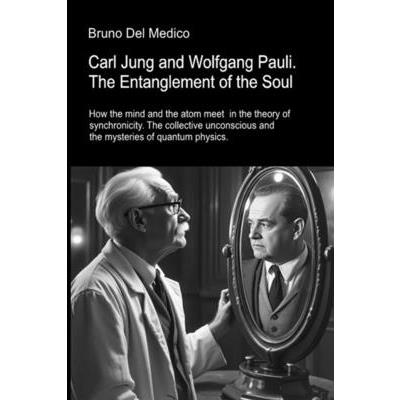
Carl Jung and Wolfgang Pauli. The Entanglement of the Soul


-
9折 820元
912元
-
 預計最高可得金幣40點
?
可100%折抵
預計最高可得金幣40點
?
可100%折抵
活動加倍另計 -
HAPPY GO享100累1點 4點抵1元 折抵無上限
-
分類:英文書>人文社科>哲學宗教>哲學思想追蹤? 追蹤分類後,您會在第一時間收到分類新品通知。
- 作者: Pensarediverso-Ing 追蹤 ? 追蹤作者後,您會在第一時間收到作者新書通知。
- 出版社: Pensarediverso-Ing 追蹤 ? 追蹤出版社後,您會在第一時間收到出版社新書通知。
- 出版日:2026/01/29

活動訊息
中文書、漫畫輕小說5折起、電子書35元起,全館滿$1,000送100點金幣

內容簡介
The history of 20th-century European culture offers few encounters as fascinating and unlikely as that between Carl Gustav Jung, Swiss psychiatrist and founder of analytical psychology, and Wolfgang Pauli, Austrian theoretical physicist and one of the fathers of quantum mechanics. Their collaboration, which began in 1932 and lasted for more than twenty years, represents one of the most daring explorations of the borderlands between psychology and physics.
This unique collaboration took place during a particularly dramatic period. It began in the 1930s, when Europe was going through a deep crisis: the Great War had just left a heavy legacy of unrest. The next event, World War II, was already foreshadowed by political and cultural upheavals. However, the intellectual climate was one of the most fertile in European history: new ideas were sweeping through physics, philosophy, and psychology. Jung led a group of scholars and therapists in Zurich. He was searching for a depth psychology capable of explaining the great myths, religions, and symbols of humanity. Pauli was also in Zurich, at the Institute of Physics, after contributing in 1925 to the exclusion principle that bears his name. This principle revolutionized atomic physics.
Jung was fascinated by science but perceived its limitations, especially in reducing reality to what is quantifiable. Pauli, a man of rigorous science but with a restless spirit, suffered a deep personal crisis after the death of his mother and the failure of his marriage. In 1932, he turned to Jung for psychotherapeutic counseling. This encounter marked the beginning of a surprising dialogue, half therapeutic, half philosophical, known as the " ." More than 800 letters from this dialogue remain, published years later and now read as a unique historical event.
Jung recognized Pauli as an exceptional interlocutor. Pauli was a friend and colleague of Einstein, Bohr, and Heisenberg, and in 1945 she received the Nobel Prize; however, her scientific lucidity did not exclude a sensitivity to the themes of the unconscious, symbolism, and dreams. In fact, Pauli stimulated Jung with his dreams: visions populated by archetypal symbols, mandalas, and alchemical figures. Pauli dreamed of a "world of shadows" populated by mysterious animals, wheels, and crosses-images that Jung interpreted as signs of the search for a balance between opposites, between scientific rationality and spiritual instinct.
This gave rise to the theory of synchronicity, a concept that Jung developed in the 1940s and defined comprehensively for the first time in 1952 in his famous essay written jointly with Pauli: "Synchronicity as the principle of acausal connections." Synchronicity describes the "meaningful coincidence" between psychic events and physical phenomena, events connected not by material causes but by shared meanings. It is a theory that dares to question the dogma of classical causality, the pillar that had supported modern science since Newton.
In 1948, in Jung's famous "Psychological Club" in K羹snacht, Pauli presented his ideas to an attentive audience: "There is a level, perhaps, where matter and mind are two sides of the same reality." It is an idea that anticipates many of today's debates on neuroscience, the origins of consciousness, and the limits of scientific knowledge.
The collaboration between Jung and Pauli left a profound legacy. It inspired scholars such as Marie-Louise von Franz, an analytical psychologist and collaborator of Jung, and physicists such as David Bohm. The collective unconscious, theorized by Jung, and the mysteries of quantum entanglement continue to suggest that the boundaries between mind and matter are less clear-cut than traditional science has wanted to believe.
配送方式
-
台灣
- 國內宅配:本島、離島
-
到店取貨:
 不限金額免運費



-
海外
- 國際快遞:全球
-
港澳店取:


訂購/退換貨須知
加入金石堂 LINE 官方帳號『完成綁定』,隨時掌握出貨動態:


商品運送說明:
- 本公司所提供的產品配送區域範圍目前僅限台灣本島。注意!收件地址請勿為郵政信箱。
- 商品將由廠商透過貨運或是郵局寄送。消費者訂購之商品若無法送達,經電話或 E-mail無法聯繫逾三天者,本公司將取消該筆訂單,並且全額退款。
- 當廠商出貨後,您會收到E-mail出貨通知,您也可透過【訂單查詢】確認出貨情況。
- 產品顏色可能會因網頁呈現與拍攝關係產生色差,圖片僅供參考,商品依實際供貨樣式為準。
- 如果是大型商品(如:傢俱、床墊、家電、運動器材等)及需安裝商品,請依商品頁面說明為主。訂單完成收款確認後,出貨廠商將會和您聯繫確認相關配送等細節。
- 偏遠地區、樓層費及其它加價費用,皆由廠商於約定配送時一併告知,廠商將保留出貨與否的權利。
提醒您!!
金石堂及銀行均不會請您操作ATM! 如接獲電話要求您前往ATM提款機,請不要聽從指示,以免受騙上當!
退換貨須知:
**提醒您,鑑賞期不等於試用期,退回商品須為全新狀態**
-
依據「消費者保護法」第19條及行政院消費者保護處公告之「通訊交易解除權合理例外情事適用準則」,以下商品購買後,除商品本身有瑕疵外,將不提供7天的猶豫期:
- 易於腐敗、保存期限較短或解約時即將逾期。(如:生鮮食品)
- 依消費者要求所為之客製化給付。(客製化商品)
- 報紙、期刊或雜誌。(含MOOK、外文雜誌)
- 經消費者拆封之影音商品或電腦軟體。
- 非以有形媒介提供之數位內容或一經提供即為完成之線上服務,經消費者事先同意始提供。(如:電子書、電子雜誌、下載版軟體、虛擬商品…等)
- 已拆封之個人衛生用品。(如:內衣褲、刮鬍刀、除毛刀…等)
- 若非上列種類商品,均享有到貨7天的猶豫期(含例假日)。
- 辦理退換貨時,商品(組合商品恕無法接受單獨退貨)必須是您收到商品時的原始狀態(包含商品本體、配件、贈品、保證書、所有附隨資料文件及原廠內外包裝…等),請勿直接使用原廠包裝寄送,或於原廠包裝上黏貼紙張或書寫文字。
- 退回商品若無法回復原狀,將請您負擔回復原狀所需費用,嚴重時將影響您的退貨權益。


商品評價