




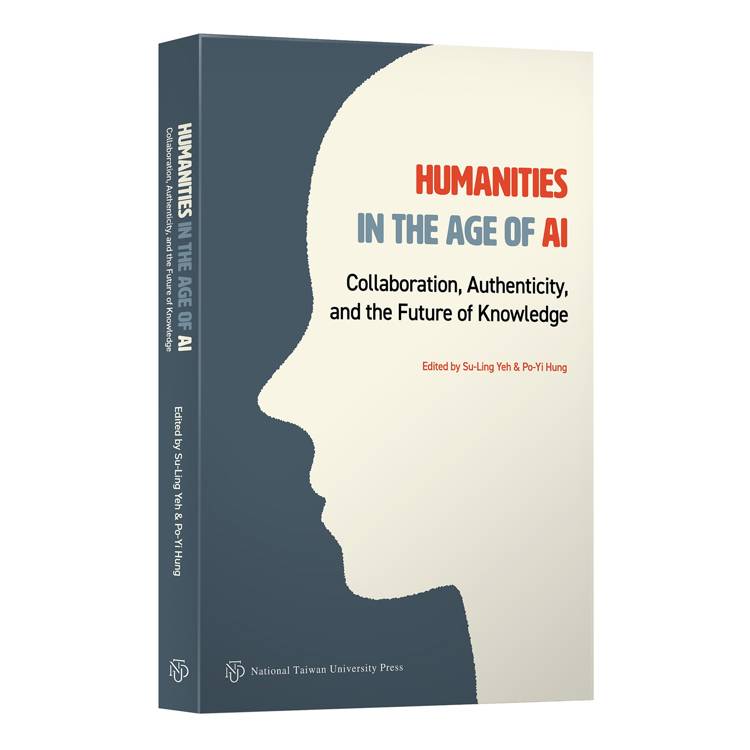
Humanities in the Age of AI: Collaboration, Authenticity, and the Future of Knowledge



-
 預計最高可得金幣45點
?
可100%折抵
活動加倍另計 -
HAPPY GO享100累1點 4點抵1元 折抵無上限
-
分類:追蹤? 追蹤分類後,您會在第一時間收到分類新品通知。
- 作者: Su-Ling Yeh、Po-Yi Hung/編者 追蹤 ? 追蹤作者後,您會在第一時間收到作者新書通知。
- 出版社: 臺灣大學 追蹤 ? 追蹤出版社後,您會在第一時間收到出版社新書通知。
- 出版日:2026/11/20
活動訊息
金石堂閱讀週年慶第二波

第48次中小學生讀物選介

內容簡介
How do thinking, understanding, interpretation, and human judgment evolve in the age of artificial intelligence? Bringing together thirteen scholars from the humanities, social sciences, and AI research, this edited volume investigates the future of critical inquiry through philosophy, literature, field research, digital humanities, library science, history, and pedagogy.
Moving beyond reductive views of AI as a mere tool, threat or object of critique, these ten chapters explore how AI and the humanities transform one another. Together, the contributors examine what meaningful collaboration demands and how responsibility and the future of knowledge must be reimagined in the age of AI.
Moving beyond reductive views of AI as a mere tool, threat or object of critique, these ten chapters explore how AI and the humanities transform one another. Together, the contributors examine what meaningful collaboration demands and how responsibility and the future of knowledge must be reimagined in the age of AI.
目錄
Editors & Contributors
Introduction: Thinking Beyond the Known╱Po-Yi Hung & Su-Ling Yeh
Part I Authenticity, Absence, and Accessibility—AI and the Knowledge Production of Humanities
1 On Thinking and Knowing (Nothing) in the Age of AI╱Katherine Davies
2 Since AI Never Dies: Reimagining the Humanities in an Era of Algorithmic Immortality╱Shuo-Bin Su
3 Analogies of AI Algorithms╱Juliette Paul
4 Repositioning On-Site Field Research Between Human-Led and AI-Assisted Methodologies╱Huai-Hsuan Chen & Po-Yi Hung
Part II AI in Research and Knowledge Production
5 AI, Authenticity and Authentic Learning╱Lynn Mie Itagaki
6 Human Observations on the Development of Artificial Intelligence╱Rachel Levy
7 Reimagining the Two Cultures: A Case Study of Integrating Humanities and AI with TAIHU╱Te-Yi Hsieh & Su-Ling Yeh
8 Artificial Intelligence for Library Cataloging: Revolutionizing Access to Knowledge╱Sam Kome
Part III AI in Education and Learning Practices
9 Researching, Teaching, and Learning: History Students Using AI╱Sally Hadden
10 Cartographies in History Education: Interactive Map Comparison, Multivocal Thinking and Digital Pedagogy╱Xiaolin Duan & Tanmai Vemulapalli
Epilogue: From an Invitation to a Book╱Su-Ling Yeh & Po-Yi Hung
Index
序/導讀
Introduction: Thinking Beyond the Known (Excerpt)
Po-Yi Hung & Su-Ling Yeh
The Urgency of This Moment
This book began at a symposium in Taipei in November 2024, where humanities scholars, social scientists, data scientists, and AI engineers from Taiwan, the United States, and beyond were asked to sit together and think aloud about meaning, data, place, and knowledge. What emerged was neither the triumphalist claim that AI would soon render humanistic inquiry obsolete, nor the defensive reassurance that the humanities need not worry at all, but something more productive and more honest: a shared recognition that we are living through a genuine epistemic rupture, and that navigating it well demands sustained, interdisciplinary, and critical conversation. (How a day of talks and a dinner-table remark became this volume is a story we save for the Epilogue.)
The ten chapters gathered here span philosophy, geography, anthropology, literary studies, history, data science, library science, psychology, and pedagogy. Their contributors bring different methodological commitments, different relationships to AI tools, and different convictions about what is at stake. What they share is a refusal of easy answers; together, they constitute a sustained effort to think carefully, from within the humanities, about what the emergence of artificial intelligence means for knowledge, for teaching, for research practice, and for what it means to be human. We are publishing this book at a moment when that question is more urgent than ever. Since the public release of ChatGPT in late 2022, generative AI has moved from the margins of public conversation to its center. Large language models (LLMs) can now draft essays, generate research summaries, analyze archival documents, compose poetry, produce code, and simulate the texture of human personality with a fluency that, only a few years ago, belonged to science fiction.
In higher education, the implications have been immediate and disorienting. Students submit AI-generated work; instructors redesign assignments overnight; institutions scramble to formulate policies. In research, AI tools are reshaping how scholars locate sources, identify patterns, synthesize literatures, and present arguments. In cultural life, deepfakes, AI-generated art, and algorithmic curation are challenging long-standing assumptions about authorship, authenticity, and originality, and in the process, as Safiya Umoja Noble has shown, amplifying longstanding patterns of racial and gendered discrimination (Noble, 2018).
Yet for all the urgency of these practical disruptions, the deeper questions raised by AI are not new. They are, at their core, the questions that the humanities have always asked. What does it mean to know something? What is the difference between information and understanding? What makes an act of interpretation distinctively human? What are our obligations to the communities whose lives we study and represent? What kind of knowledge—and what kind of knower—do we want to cultivate?
These are questions that cannot be answered by optimizing a loss function or scaling up a training dataset. They require the slow, reflective, historically informed, and ethically attentive inquiry that the humanities have long practiced, and that Martin Heidegger, in his own reckoning with the technological, called Gelassenheit: a meditative, questioning openness to what technology both reveals and conceals (Heidegger, 1969).
This, in essence, is why this book is needed now: not to defend the humanities against AI, but to ask what the age of AI requires of us.
……
The Architecture of the Volume
The ten chapters of this book are organized into three parts, each of which approaches the AI-humanities relationship from a different angle. These three parts are not sequential stages of a single argument. They are better understood as three interlocking dimensions of one larger problem: how collaboration, authenticity, and the future of knowledge must be rethought in the age of AI.
Part I addresses the foundational epistemological and ontological questions that AI raises about human knowledge production. Part II examines how AI is reshaping research practices and knowledge systems across multiple fields. Part III turns to education, asking how teachers and students might engage AI critically and productively in processes of learning. Together, the three parts move from the philosophical and conceptual to the methodological and pedagogical, while remaining throughout attentive to the ethical stakes of the choices being made.
Read in relation to the book’s title, the architecture of the volume becomes clearer. Collaboration is most explicit in Part II, where interdisciplinary research infrastructures, institutional workflows, and human-in-the-loop systems come into view; yet it is already present in Part I as a philosophical question about what kinds of relation between humans and machines are possible, and it returns in Part III as a pedagogical question about how teachers and students should work with AI rather than simply around it. Authenticity appears most directly in Part I, where the volume asks what remains distinctively human in thinking, mortality, situated presence, and interpretive judgment; but it also takes on political urgency in Part II, especially in Chapter 5, and practical educational force in Part III. The future of knowledge names the horizon that binds all three parts together: not simply the accumulation of more information, but the changing conditions under which knowledge is generated, validated, taught, contested, and shared.
One deliberate crossing deserves particular note. Authenticity names the first of our three broad concerns, yet it receives its most overtly political treatment not in Part I but in Chapter 5, in Part II, where Lynn Mie Itagaki reads it through Asian American studies and postcolonial critique. This is by design rather than oversight. Authenticity is less a topic that can be confined to one section than a thread that runs through the entire volume, appearing as a phenomenological question in Part I, as a political and pedagogical question in Part II, and as a problem of representation, expertise, and judgment in Part III. Readers may find it useful to hold the concept loosely and watch how it changes shape as disciplinary context shifts.
……
An Occasion for Thinking
This book does not offer final answers. The situation it addresses is moving faster than any book can track: by the time these pages are printed, new AI systems will have been released, new capabilities demonstrated, new crises provoked. What we hope to offer, instead, is a set of conceptual tools, disciplinary perspectives, and case studies that can help readers think more clearly and more responsibly about a transformation that is already well underway.
We address this book to several audiences simultaneously: to humanities scholars who are grappling, in their research and teaching, with the implications of AI for their disciplines; to scientists and engineers who are building AI systems and who want to understand what is at stake for the human values and cultural complexities their technologies engage; to students who are navigating, often without adequate guidance, the new landscape of knowledge production and learning; and to policymakers, librarians, educators, and knowledge workers of all kinds who are making consequential decisions about how AI will be adopted, governed, and held to account.
Hannah Arendt wrote, in the preface to The Human Condition, that the arrival of Sputnik signaled not a triumph but a question: whether human beings, having acquired the power to act on scales previously reserved for natural and cosmic forces, still possessed the wisdom to deliberate about what they were doing, and why (Arendt, 2018). The chapters that follow are, in different ways, efforts to think about preciselythat question as it presents itself in our own moment. They are offered not as conclusions, but as contributions to a conversation that is, by its nature, unfinishable: what it means to be human, to know, to think, and to be responsible, in an age that asks these questions with new and demanding urgency. We hope that readers will find in these pages not only information, but an occasion for thinkin
贈品
指定商品滿$888即贈 閱讀隨行袋(款式隨機)
凡全站商品單筆訂單滿888元,即送「閱讀隨行袋」1個,款式隨機出貨。(數量有限,送完為止)
※ 海外訂單恕不提供贈品。
贈品已送完

指定商品滿$3500即贈 小編私藏禮
凡週年慶期間指定商品滿3500即贈小編私藏禮一份
※ 海外訂單恕不提供贈品。
贈品已送完

配送方式
-
台灣
- 國內宅配:本島、離島
-
到店取貨:
 不限金額免運費



-
海外
- 國際快遞:全球
-
港澳店取:


詳細資料
詳細資料
-
- 語言
- 中文繁體
- 裝訂
- 紙本平裝
-
- ISBN
- 9786267944516
- 分級
- 普通級
-
- 頁數
- 328
- 商品規格
- 23.5*15.8*1.7
-
- 出版地
- 台灣
- 適讀年齡
- 全齡適讀
-
- 注音
- 級別
訂購/退換貨須知
加入金石堂 LINE 官方帳號『完成綁定』,隨時掌握出貨動態:


提醒您!!
金石堂及銀行均不會請您操作ATM! 如接獲電話要求您前往ATM提款機,請不要聽從指示,以免受騙上當!
退換貨須知:
**提醒您,鑑賞期不等於試用期,退回商品須為全新狀態**
-
依據「消費者保護法」第19條及行政院消費者保護處公告之「通訊交易解除權合理例外情事適用準則」,以下商品購買後,除商品本身有瑕疵外,將不提供7天的猶豫期:
- 易於腐敗、保存期限較短或解約時即將逾期。(如:生鮮食品)
- 依消費者要求所為之客製化給付。(客製化商品)
- 報紙、期刊或雜誌。(含MOOK、外文雜誌)
- 經消費者拆封之影音商品或電腦軟體。
- 非以有形媒介提供之數位內容或一經提供即為完成之線上服務,經消費者事先同意始提供。(如:電子書、電子雜誌、下載版軟體、虛擬商品…等)
- 已拆封之個人衛生用品。(如:內衣褲、刮鬍刀、除毛刀…等)
- 若非上列種類商品,均享有到貨7天的猶豫期(含例假日)。
- 辦理退換貨時,商品(組合商品恕無法接受單獨退貨)必須是您收到商品時的原始狀態(包含商品本體、配件、贈品、保證書、所有附隨資料文件及原廠內外包裝…等),請勿直接使用原廠包裝寄送,或於原廠包裝上黏貼紙張或書寫文字。
- 退回商品若無法回復原狀,將請您負擔回復原狀所需費用,嚴重時將影響您的退貨權益。


商品評價
評價規範