





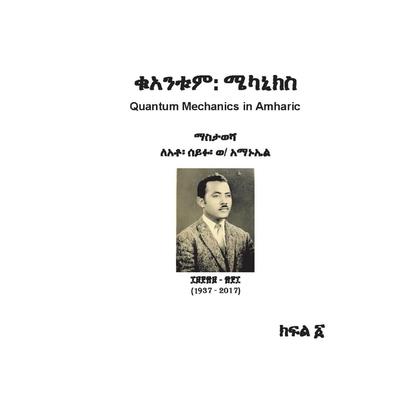
Quantum Mechanics in Amharic
Quantum Mechanics in Amharic




活動訊息
普發一萬放大術:滿千登記抽萬元好禮

大數據幫你找下一本愛書!今天填寫,隔天立刻揭曉!

內容簡介
Quantum Mechanics in Amharic, to my knowledge, is the first book on quantum mechanics to use the rich expressions of the Amharic language, which has a long history. Since the late twelfth century, Amharic has been the working language of Ethiopia's courts, military, trade, and daily communication, and it remains the country's official language. The recent census indicates that there are 22 million native Amharic speakers and 4 million secondary speakers in Ethiopia. There are also over 3 million Amharic-speaking emigrants outside Ethiopia. The Ethiopian Jewish communities in Ethiopia and Israel as well as the Ethiopian diaspora in and around Washington, D.C. speak Amharic. Amharic is one of the six non-English languages included in Washington's Language Access Act of 2004, thus ensuring citizens access to government services and education in Amharic. While Ethiopian Christians regard Ge'ez--Amharic's root language--as holy, Amharic is the holy language of the Rastafari religion and is widely used by its followers worldwide. The script of the Amharic language is known as an abugida, and the graphemes of its writing system are called fidel. These graphemes are displayed on the last page of Quantum Mechanics in Amharic surrounded by the green, yellow, and red of the original Ethiopian flag, which remains an icon of freedom because Ethiopia is the only non-colonized nation in Africa. Each fidel, which represents a consonant and vowel sequence, has a shape determined by its consonant and modified by its vowel.
The primary language of quantum mechanics, one of the many branches of physics, is mathematics. However, everyday language is required to explain in depth the laws of physics that are presented using mathematical expressions. The book's introduction briefly describes the historical roots of quantum mechanics, starting with natural philosophy from 400 BC. Although some civilizations, such as Ethiopia's Aksumite civilization, date well before this to 3000 BC, there are some indications of knowledge transfer from earlier civilizations to more recent ones. The book then follows the historical timeline through the present state of quantum mechanics, describing several interesting phenomena that can only be explained using quantum mechanics, such as quantum tunneling, causality, the nature of reality, duality, entanglement, superposition, and quantum scattering. The first three of these are described in detail. The first chapter briefly explains the underlying physics essential to understanding quantum mechanics. It also explores some current quantum mechanics research and potential future applications, including quantum computers, quantum teleportation, and nano-science/technology. The second chapter presents the Schr繹dinger equation and the wave function, including wave-particle duality. The third chapter introduces readers to the time-independent Schr繹dinger equation and its applications in solving the state of a one-dimensional particle in five different potentials. The end of the book includes translations of over 130 words and lists a few useful references. Readers are given exercises to complete throughout the book, including proofs after example proofs are presented.
Books such as Quantum Mechanics in Amharic that are written in indigenous languages on advanced topics will be useful for the Einstein Project in Africa. It has been over a century since 1905, the so-called "Miracle Year" of Einstein, and the world has not since witnessed another scientist of his caliber. It is possible that his successor will be a child in Africa who does not have access to modern education. Science books in indigenous languages may help lift this barrier.
The primary language of quantum mechanics, one of the many branches of physics, is mathematics. However, everyday language is required to explain in depth the laws of physics that are presented using mathematical expressions. The book's introduction briefly describes the historical roots of quantum mechanics, starting with natural philosophy from 400 BC. Although some civilizations, such as Ethiopia's Aksumite civilization, date well before this to 3000 BC, there are some indications of knowledge transfer from earlier civilizations to more recent ones. The book then follows the historical timeline through the present state of quantum mechanics, describing several interesting phenomena that can only be explained using quantum mechanics, such as quantum tunneling, causality, the nature of reality, duality, entanglement, superposition, and quantum scattering. The first three of these are described in detail. The first chapter briefly explains the underlying physics essential to understanding quantum mechanics. It also explores some current quantum mechanics research and potential future applications, including quantum computers, quantum teleportation, and nano-science/technology. The second chapter presents the Schr繹dinger equation and the wave function, including wave-particle duality. The third chapter introduces readers to the time-independent Schr繹dinger equation and its applications in solving the state of a one-dimensional particle in five different potentials. The end of the book includes translations of over 130 words and lists a few useful references. Readers are given exercises to complete throughout the book, including proofs after example proofs are presented.
Books such as Quantum Mechanics in Amharic that are written in indigenous languages on advanced topics will be useful for the Einstein Project in Africa. It has been over a century since 1905, the so-called "Miracle Year" of Einstein, and the world has not since witnessed another scientist of his caliber. It is possible that his successor will be a child in Africa who does not have access to modern education. Science books in indigenous languages may help lift this barrier.
配送方式
-
台灣
- 國內宅配:本島、離島
-
到店取貨:
 不限金額免運費



-
海外
- 國際快遞:全球
-
港澳店取:


訂購/退換貨須知
加入金石堂 LINE 官方帳號『完成綁定』,隨時掌握出貨動態:


商品運送說明:
- 本公司所提供的產品配送區域範圍目前僅限台灣本島。注意!收件地址請勿為郵政信箱。
- 商品將由廠商透過貨運或是郵局寄送。消費者訂購之商品若無法送達,經電話或 E-mail無法聯繫逾三天者,本公司將取消該筆訂單,並且全額退款。
- 當廠商出貨後,您會收到E-mail出貨通知,您也可透過【訂單查詢】確認出貨情況。
- 產品顏色可能會因網頁呈現與拍攝關係產生色差,圖片僅供參考,商品依實際供貨樣式為準。
- 如果是大型商品(如:傢俱、床墊、家電、運動器材等)及需安裝商品,請依商品頁面說明為主。訂單完成收款確認後,出貨廠商將會和您聯繫確認相關配送等細節。
- 偏遠地區、樓層費及其它加價費用,皆由廠商於約定配送時一併告知,廠商將保留出貨與否的權利。
提醒您!!
金石堂及銀行均不會請您操作ATM! 如接獲電話要求您前往ATM提款機,請不要聽從指示,以免受騙上當!
退換貨須知:
**提醒您,鑑賞期不等於試用期,退回商品須為全新狀態**
-
依據「消費者保護法」第19條及行政院消費者保護處公告之「通訊交易解除權合理例外情事適用準則」,以下商品購買後,除商品本身有瑕疵外,將不提供7天的猶豫期:
- 易於腐敗、保存期限較短或解約時即將逾期。(如:生鮮食品)
- 依消費者要求所為之客製化給付。(客製化商品)
- 報紙、期刊或雜誌。(含MOOK、外文雜誌)
- 經消費者拆封之影音商品或電腦軟體。
- 非以有形媒介提供之數位內容或一經提供即為完成之線上服務,經消費者事先同意始提供。(如:電子書、電子雜誌、下載版軟體、虛擬商品…等)
- 已拆封之個人衛生用品。(如:內衣褲、刮鬍刀、除毛刀…等)
- 若非上列種類商品,均享有到貨7天的猶豫期(含例假日)。
- 辦理退換貨時,商品(組合商品恕無法接受單獨退貨)必須是您收到商品時的原始狀態(包含商品本體、配件、贈品、保證書、所有附隨資料文件及原廠內外包裝…等),請勿直接使用原廠包裝寄送,或於原廠包裝上黏貼紙張或書寫文字。
- 退回商品若無法回復原狀,將請您負擔回復原狀所需費用,嚴重時將影響您的退貨權益。


商品評價