





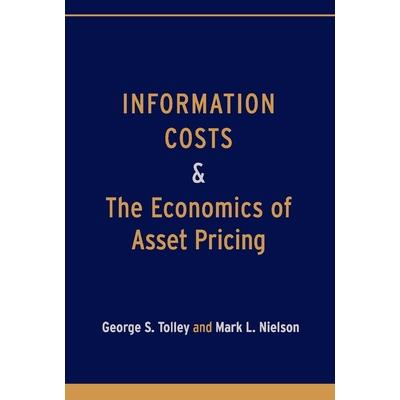
Information Costs and the Economics of Asset Pricing
Information Costs and the Economics of Asset Pricing





活動訊息
全館滿$1,200送150點金幣,4月歡慶兒童節,童書、玩具、文具滿1000元再送200點金幣!

內容簡介
An explanation of asset pricing is developed based on aggregating the portfolio choices of individual investors. Recognition is given to investor information costs. Portfolio risk is lowered by increasing the number of securities an investor holds, giving Markowitz-type diversification gains. Investigation costs required for any additional security raises costs. Investigation costs are pushed to the point where the marginal gain from diversifying to one more security just offsets the marginal loss from spreading information costs over an additional security. The same comparison of marginal cost and marginal gain of adding a security applies to each security being considered for inclusion. The result is that every security in the portfolio chosen by the investor is of identical riskiness.
Investors sort to securities of their individual desired level of riskiness. Each investor holds only a small fraction of the total number of securities. They are in competition to buy the total supply of securities. Prices must be such that the market for all securities clears. As investors jockey for position in holding securities of varying riskiness, they will make bids only against those who have chosen securities of a similar risk level, since investors who have different risk preferences will be competing for securities of a different riskiness. While the investors will be ranked with riskier securities commanding higher returns,
there are many ways of ranking securities in such an order. The impasse between competing investors is broken by the relative change in slope i.e. the relative change in rise in riskiness, or change as given by the second derivative of the risk-return relation as riskiness increases. Market stability requires that the second derivative of the market risk relation is negative. The demand parameters of individual investors must be brought in, in such a way as to conform to the risk return slope conditions for the risk return relation, and these need to be related to the supply conditions for securities to ensure that demand and supply for securities at each level of security riskiness are equal. The derivative of the slope of the risk return relation is equal to the absolute value of the ratio of density of supply to density of demand at that level of riskiness. Expected return r is expected return on the least risky security r0 plus the integral of the slope dr/dR from that of the least risky security up to that of the security in question: r=r0+R0?R{(dr/dR)0+R0?R[-j(R)/h(dr/dR)dR]dR}dR This result is for the case where investors differ in risk aversion but their information cost functions are identical, as may be reasonable where brokers and other intermediary investors draw on similar pools of security analysts. The case of investors with dissimilar information cost functions is briefly considered as a prelude to explaining security market fluctuations and disequilibria. The next part of the study embeds the asset pricing explanation of this book in a Lucas-type macroeconomic model. The asset pricing explanation developed in this book still applies, subject to the proviso that the least risky security held by any investor conforms to the Euler equation for optimal saving. The effects of risk on saving are explored, bringing out that the saving decision of the household is an endogenous choice. Next the relation of the explanation of asset prices in this book to consumption capm is explored. In consumption capm every investor holds every asset, whereas in this book each investor holds only a few assets. Our explanation encounters no equity-premium puzzle. Using historical U.S. data, we make a preliminary estimate of the long run risk return relation for the U.S. It has common sense appeal and paves the way for more refined estimation.
Investors sort to securities of their individual desired level of riskiness. Each investor holds only a small fraction of the total number of securities. They are in competition to buy the total supply of securities. Prices must be such that the market for all securities clears. As investors jockey for position in holding securities of varying riskiness, they will make bids only against those who have chosen securities of a similar risk level, since investors who have different risk preferences will be competing for securities of a different riskiness. While the investors will be ranked with riskier securities commanding higher returns,
there are many ways of ranking securities in such an order. The impasse between competing investors is broken by the relative change in slope i.e. the relative change in rise in riskiness, or change as given by the second derivative of the risk-return relation as riskiness increases. Market stability requires that the second derivative of the market risk relation is negative. The demand parameters of individual investors must be brought in, in such a way as to conform to the risk return slope conditions for the risk return relation, and these need to be related to the supply conditions for securities to ensure that demand and supply for securities at each level of security riskiness are equal. The derivative of the slope of the risk return relation is equal to the absolute value of the ratio of density of supply to density of demand at that level of riskiness. Expected return r is expected return on the least risky security r0 plus the integral of the slope dr/dR from that of the least risky security up to that of the security in question: r=r0+R0?R{(dr/dR)0+R0?R[-j(R)/h(dr/dR)dR]dR}dR This result is for the case where investors differ in risk aversion but their information cost functions are identical, as may be reasonable where brokers and other intermediary investors draw on similar pools of security analysts. The case of investors with dissimilar information cost functions is briefly considered as a prelude to explaining security market fluctuations and disequilibria. The next part of the study embeds the asset pricing explanation of this book in a Lucas-type macroeconomic model. The asset pricing explanation developed in this book still applies, subject to the proviso that the least risky security held by any investor conforms to the Euler equation for optimal saving. The effects of risk on saving are explored, bringing out that the saving decision of the household is an endogenous choice. Next the relation of the explanation of asset prices in this book to consumption capm is explored. In consumption capm every investor holds every asset, whereas in this book each investor holds only a few assets. Our explanation encounters no equity-premium puzzle. Using historical U.S. data, we make a preliminary estimate of the long run risk return relation for the U.S. It has common sense appeal and paves the way for more refined estimation.
配送方式
-
台灣
- 國內宅配:本島、離島
-
到店取貨:
 不限金額免運費



-
海外
- 國際快遞:全球
-
港澳店取:


訂購/退換貨須知
加入金石堂 LINE 官方帳號『完成綁定』,隨時掌握出貨動態:


商品運送說明:
- 本公司所提供的產品配送區域範圍目前僅限台灣本島。注意!收件地址請勿為郵政信箱。
- 商品將由廠商透過貨運或是郵局寄送。消費者訂購之商品若無法送達,經電話或 E-mail無法聯繫逾三天者,本公司將取消該筆訂單,並且全額退款。
- 當廠商出貨後,您會收到E-mail出貨通知,您也可透過【訂單查詢】確認出貨情況。
- 產品顏色可能會因網頁呈現與拍攝關係產生色差,圖片僅供參考,商品依實際供貨樣式為準。
- 如果是大型商品(如:傢俱、床墊、家電、運動器材等)及需安裝商品,請依商品頁面說明為主。訂單完成收款確認後,出貨廠商將會和您聯繫確認相關配送等細節。
- 偏遠地區、樓層費及其它加價費用,皆由廠商於約定配送時一併告知,廠商將保留出貨與否的權利。
提醒您!!
金石堂及銀行均不會請您操作ATM! 如接獲電話要求您前往ATM提款機,請不要聽從指示,以免受騙上當!
退換貨須知:
**提醒您,鑑賞期不等於試用期,退回商品須為全新狀態**
-
依據「消費者保護法」第19條及行政院消費者保護處公告之「通訊交易解除權合理例外情事適用準則」,以下商品購買後,除商品本身有瑕疵外,將不提供7天的猶豫期:
- 易於腐敗、保存期限較短或解約時即將逾期。(如:生鮮食品)
- 依消費者要求所為之客製化給付。(客製化商品)
- 報紙、期刊或雜誌。(含MOOK、外文雜誌)
- 經消費者拆封之影音商品或電腦軟體。
- 非以有形媒介提供之數位內容或一經提供即為完成之線上服務,經消費者事先同意始提供。(如:電子書、電子雜誌、下載版軟體、虛擬商品…等)
- 已拆封之個人衛生用品。(如:內衣褲、刮鬍刀、除毛刀…等)
- 若非上列種類商品,均享有到貨7天的猶豫期(含例假日)。
- 辦理退換貨時,商品(組合商品恕無法接受單獨退貨)必須是您收到商品時的原始狀態(包含商品本體、配件、贈品、保證書、所有附隨資料文件及原廠內外包裝…等),請勿直接使用原廠包裝寄送,或於原廠包裝上黏貼紙張或書寫文字。
- 退回商品若無法回復原狀,將請您負擔回復原狀所需費用,嚴重時將影響您的退貨權益。



商品評價