




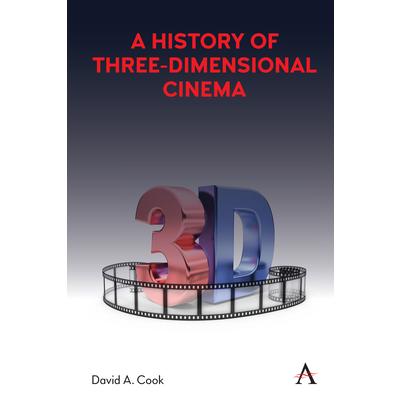
A History of Three-Dimensional Cinema




活動訊息
全館滿$1,200送150點金幣,4月歡慶兒童節,童書、玩具、文具滿1000元再送200點金幣!

內容簡介
In human binocular vision, the lenses of our eyes project two slightly different images onto the retinas and our brain calculates the difference between them as actual depth. Stereoscopy replicates this process by providing left-eye views and right-eye views (stereo pairs) of the same picture at slightly different angles which, when viewed simultaneously, create the illusion of depth (stereopsis). In 1844 Sir David Brewster invented a handheld apparatus for viewing stereoscopic photographs through a system of prismatic lenses, with the stereo pairs mounted on a single card. During the 1870s, a popular theatrical entertainment involved the projection of duo-color coded slides onto a large screen to be viewed through glasses with corresponding left and right colored cells to produce a stereoscopic illusion, known as "anaglyphic" 3-D.
With the development of motion pictures, it was natural that pioneers like William Friese-Green and the Lumiere brothers would experiment with anaglyphic systems, since the photographic principle was the same. But commercial exploitation of the process awaited 1952, when independent producer Arch Oboler released Bwana Devil, a low-budget Anscocolor feature whose phenomenal box-office success catalyzed a short, industry-wide conversion to 3-D. Between 1953 and 1954, Hollywood produced 69 features in 3-D, mostly action films that could exploit the depth illusion, such as Westerns, science fiction, and horror films--all of them shot in some version of Oboler's Natural Vision. With some modification, such as the introduction of twin-lens cameras and projectors, this was the process used for nearly all the 3-D films made between 1953 and 2009, when James Cameron's Avatar became the highest-grossing feature of all time and the studios once again stampeded into 3-D production, this time in the more perceptually satisfying (and, ultimately, cost-effective) digital form.
While all 3-D systems fool our brains into believing that something is either closer or farther away than it actually is, older systems tended to represent depth as a series of dimensionally flat planes like an eighteenth-century peep show, whereas digital systems add the effect of volumetric figures occupying real space, creating a kind of "aesthetics of immersion." Yet the ultimate technology for seeing things in three dimensions is Virtual Reality (VR), which uses a hybrid of advanced modern technology--Lidar scanners, hyper-accelerated graphic cards, etc.--and the stereoscopic illusion first quantified in the nineteenth century to create a state of sensory immersion that borders on otherness. Finding a way to mass-market the VR experience as a form of popular cinema, rather than as an enhanced form of video game, has become the new grail of the film industry.
配送方式
-
台灣
- 國內宅配:本島、離島
-
到店取貨:
-
海外
- 國際快遞:全球
訂購/退換貨須知
加入金石堂 LINE 官方帳號『完成綁定』,隨時掌握出貨動態:


商品運送說明:
- 本公司所提供的產品配送區域範圍目前僅限台灣本島。注意!收件地址請勿為郵政信箱。
- 商品將由廠商透過貨運或是郵局寄送。消費者訂購之商品若無法送達,經電話或 E-mail無法聯繫逾三天者,本公司將取消該筆訂單,並且全額退款。
- 當廠商出貨後,您會收到E-mail出貨通知,您也可透過【訂單查詢】確認出貨情況。
- 產品顏色可能會因網頁呈現與拍攝關係產生色差,圖片僅供參考,商品依實際供貨樣式為準。
- 如果是大型商品(如:傢俱、床墊、家電、運動器材等)及需安裝商品,請依商品頁面說明為主。訂單完成收款確認後,出貨廠商將會和您聯繫確認相關配送等細節。
- 偏遠地區、樓層費及其它加價費用,皆由廠商於約定配送時一併告知,廠商將保留出貨與否的權利。
提醒您!!
金石堂及銀行均不會請您操作ATM! 如接獲電話要求您前往ATM提款機,請不要聽從指示,以免受騙上當!
退換貨須知:
**提醒您,鑑賞期不等於試用期,退回商品須為全新狀態**
-
依據「消費者保護法」第19條及行政院消費者保護處公告之「通訊交易解除權合理例外情事適用準則」,以下商品購買後,除商品本身有瑕疵外,將不提供7天的猶豫期:
- 易於腐敗、保存期限較短或解約時即將逾期。(如:生鮮食品)
- 依消費者要求所為之客製化給付。(客製化商品)
- 報紙、期刊或雜誌。(含MOOK、外文雜誌)
- 經消費者拆封之影音商品或電腦軟體。
- 非以有形媒介提供之數位內容或一經提供即為完成之線上服務,經消費者事先同意始提供。(如:電子書、電子雜誌、下載版軟體、虛擬商品…等)
- 已拆封之個人衛生用品。(如:內衣褲、刮鬍刀、除毛刀…等)
- 若非上列種類商品,均享有到貨7天的猶豫期(含例假日)。
- 辦理退換貨時,商品(組合商品恕無法接受單獨退貨)必須是您收到商品時的原始狀態(包含商品本體、配件、贈品、保證書、所有附隨資料文件及原廠內外包裝…等),請勿直接使用原廠包裝寄送,或於原廠包裝上黏貼紙張或書寫文字。
- 退回商品若無法回復原狀,將請您負擔回復原狀所需費用,嚴重時將影響您的退貨權益。





商品評價