




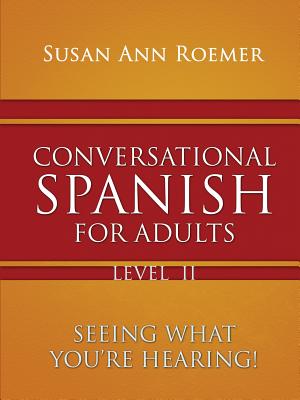
Conversational Spanish For Adults
Conversational Spanish For Adults





活動訊息
全館滿$1,200送150點金幣,4月歡慶兒童節,童書、玩具、文具滿1000元再送200點金幣!

內容簡介
Conversational Spanish For Adults
Espa簽ol Conversacional Para Adultos
es-pa-NYOL kom-ber-sa-sio-NAL PA-ra a-DUL-tos Seeing What You're Hearing!
癒Viendo Lo Que Est獺 Escuchando!
BIEN-do LO KE e-STA es-ku-CHAN-do People learn their languages by hearing words and then understanding what they mean. A child learns words, strings them together in phrases, and is later corrected by his or her parents. Imagine if a 4-year-old in saying a sentence were forced to say the complete conjugation of the verb before going on to the next phrase! Yet many people think that to learn a new language they need to learn all the conjugations before they continue. This method is in essence a "mapping of sounds". The students are taught a phrase, what it means in English, and what the sounds look like through a phonetic transcription that is unique to this method. Spanish language learners may practice the sounds without the need of an instructor being present. The advantage is clear: it is one thing to hear the sounds and repeat the words; it is quite another thing to have a visual image of what the sounds look like. Recent research confirms what many have long suspected -- most people are a combination of visual and auditory learners. It only makes sense that a teaching approach should be directed at both modalities in addition to some kinesthetic activities to reinforce the learning. The students will be able to take what was spoken in the classroom and easily reinforce it at home through additional practice. In music some people can produce music "by ear" while others need to read the music. The printed page also describes the cadence and scales, whole or half notes, etc. In some ways this approach can be compared to sheet music rather than to music produced by ear. It is helpful to have written instructions to complement the initial practice regardless of whether one is trying to communicate the same sound in music or in language learning. This gives more detail and allows the producer to repeat the message more accurately. The four modalities of learning any language are reading, writing, speaking, and listening. Research has shown that a person can master any concept in any language after being exposed to it a total of ten times. It can be a language concept, a scientific theory, or a mathematical theorem, but the important point is the need for repetition. The goal of this approach is to make learning the Spanish language repetitive without being boring! Simple phrases are repeated in multiple contexts. Students are able to reproduce the phrases outside the classroom setting in situations where they feel comfortable. Since it is usually impossible to transport students to a Spanish-speaking environment, the method by definition needs to be vicarious. Of course the more they use the phrases taught in class and reproduced outside the classroom, the faster they learn the language. With repetition in and out of class their speed and pronunciation will improve; their words and sounds will all flow together. In this method the three steps of each concept are (1) the structure; (2) an example; and (3) a given practice task for the student with a partner. In the military the same steps are implemented to teach a task -- structure, example, and practice. It only stands to reason that the more opportunities the student has to practice a given task, the more efficient the learning will be in the student's memory bank. As the old adage goes, "Practice makes perfect."
Espa簽ol Conversacional Para Adultos
es-pa-NYOL kom-ber-sa-sio-NAL PA-ra a-DUL-tos Seeing What You're Hearing!
癒Viendo Lo Que Est獺 Escuchando!
BIEN-do LO KE e-STA es-ku-CHAN-do People learn their languages by hearing words and then understanding what they mean. A child learns words, strings them together in phrases, and is later corrected by his or her parents. Imagine if a 4-year-old in saying a sentence were forced to say the complete conjugation of the verb before going on to the next phrase! Yet many people think that to learn a new language they need to learn all the conjugations before they continue. This method is in essence a "mapping of sounds". The students are taught a phrase, what it means in English, and what the sounds look like through a phonetic transcription that is unique to this method. Spanish language learners may practice the sounds without the need of an instructor being present. The advantage is clear: it is one thing to hear the sounds and repeat the words; it is quite another thing to have a visual image of what the sounds look like. Recent research confirms what many have long suspected -- most people are a combination of visual and auditory learners. It only makes sense that a teaching approach should be directed at both modalities in addition to some kinesthetic activities to reinforce the learning. The students will be able to take what was spoken in the classroom and easily reinforce it at home through additional practice. In music some people can produce music "by ear" while others need to read the music. The printed page also describes the cadence and scales, whole or half notes, etc. In some ways this approach can be compared to sheet music rather than to music produced by ear. It is helpful to have written instructions to complement the initial practice regardless of whether one is trying to communicate the same sound in music or in language learning. This gives more detail and allows the producer to repeat the message more accurately. The four modalities of learning any language are reading, writing, speaking, and listening. Research has shown that a person can master any concept in any language after being exposed to it a total of ten times. It can be a language concept, a scientific theory, or a mathematical theorem, but the important point is the need for repetition. The goal of this approach is to make learning the Spanish language repetitive without being boring! Simple phrases are repeated in multiple contexts. Students are able to reproduce the phrases outside the classroom setting in situations where they feel comfortable. Since it is usually impossible to transport students to a Spanish-speaking environment, the method by definition needs to be vicarious. Of course the more they use the phrases taught in class and reproduced outside the classroom, the faster they learn the language. With repetition in and out of class their speed and pronunciation will improve; their words and sounds will all flow together. In this method the three steps of each concept are (1) the structure; (2) an example; and (3) a given practice task for the student with a partner. In the military the same steps are implemented to teach a task -- structure, example, and practice. It only stands to reason that the more opportunities the student has to practice a given task, the more efficient the learning will be in the student's memory bank. As the old adage goes, "Practice makes perfect."
配送方式
-
台灣
- 國內宅配:本島、離島
-
到店取貨:
 不限金額免運費



-
海外
- 國際快遞:全球
-
港澳店取:


訂購/退換貨須知
加入金石堂 LINE 官方帳號『完成綁定』,隨時掌握出貨動態:


商品運送說明:
- 本公司所提供的產品配送區域範圍目前僅限台灣本島。注意!收件地址請勿為郵政信箱。
- 商品將由廠商透過貨運或是郵局寄送。消費者訂購之商品若無法送達,經電話或 E-mail無法聯繫逾三天者,本公司將取消該筆訂單,並且全額退款。
- 當廠商出貨後,您會收到E-mail出貨通知,您也可透過【訂單查詢】確認出貨情況。
- 產品顏色可能會因網頁呈現與拍攝關係產生色差,圖片僅供參考,商品依實際供貨樣式為準。
- 如果是大型商品(如:傢俱、床墊、家電、運動器材等)及需安裝商品,請依商品頁面說明為主。訂單完成收款確認後,出貨廠商將會和您聯繫確認相關配送等細節。
- 偏遠地區、樓層費及其它加價費用,皆由廠商於約定配送時一併告知,廠商將保留出貨與否的權利。
提醒您!!
金石堂及銀行均不會請您操作ATM! 如接獲電話要求您前往ATM提款機,請不要聽從指示,以免受騙上當!
退換貨須知:
**提醒您,鑑賞期不等於試用期,退回商品須為全新狀態**
-
依據「消費者保護法」第19條及行政院消費者保護處公告之「通訊交易解除權合理例外情事適用準則」,以下商品購買後,除商品本身有瑕疵外,將不提供7天的猶豫期:
- 易於腐敗、保存期限較短或解約時即將逾期。(如:生鮮食品)
- 依消費者要求所為之客製化給付。(客製化商品)
- 報紙、期刊或雜誌。(含MOOK、外文雜誌)
- 經消費者拆封之影音商品或電腦軟體。
- 非以有形媒介提供之數位內容或一經提供即為完成之線上服務,經消費者事先同意始提供。(如:電子書、電子雜誌、下載版軟體、虛擬商品…等)
- 已拆封之個人衛生用品。(如:內衣褲、刮鬍刀、除毛刀…等)
- 若非上列種類商品,均享有到貨7天的猶豫期(含例假日)。
- 辦理退換貨時,商品(組合商品恕無法接受單獨退貨)必須是您收到商品時的原始狀態(包含商品本體、配件、贈品、保證書、所有附隨資料文件及原廠內外包裝…等),請勿直接使用原廠包裝寄送,或於原廠包裝上黏貼紙張或書寫文字。
- 退回商品若無法回復原狀,將請您負擔回復原狀所需費用,嚴重時將影響您的退貨權益。


商品評價