




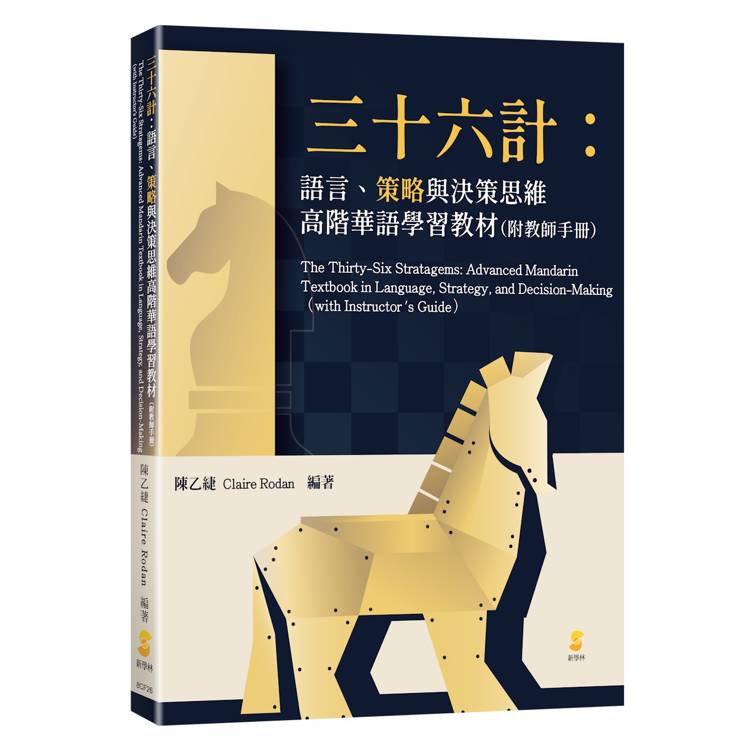
【電子書】三十六計:語言、策略與決策思維高階華語學習教材(附教師手冊)





活動訊息
金石堂2026海外優惠:電子書

內容簡介
—這不只是一本語言教材,更是一部理解中國思想、文化心理與戰略敘事的重要讀本!—
《三十六計》不僅是中國智慧與戰略思維的重要經典,更是一部濃縮語言、文化、心理與權力邏輯的思想文本。其價值不僅存在於戰術層面的應變技巧,更深植於中國文化中對局勢、關係、時機與人性的理解。
陳乙緁老師繼《孫子兵法:華語策略學習教材(附練習本)》一書後,再次以中國智慧與戰略思維原典《三十六計》為基礎,跨界結合「華語教學」、「策略思維」與「文化分析」,重新詮釋《三十六計》的語言結構、修辭邏輯與思想內涵,並進一步延伸至現代社會、國際關係、商業溝通與跨文化決策情境。
▍讀者透過此書將能深入瞭解:
• 每一計背後的隱喻思維與語言策略
• 中國文化中的間接性、權變性與情境判斷
• 策略如何透過語言、心理與敘事發揮作用
• 《三十六計》與《孫子兵法》之間的互補關係
• 華語語境中的文化邏輯與決策模式
▍書籍特色
•跨學科融合:將「古典戰略智慧」與「現代高階華語教學」完美結合,提升學習者的語言層次與思想深度。
•國際化視野:將古老計謀延伸至現代國際關係、外交、商業談判等實務情境,實用性極高。
•教學配套完整:本書貼心附帶《教學手冊》,方便華語教師進行課程設計、課堂互動與延伸討論。
▍本書適合:
• 高階華語學習者
• 華語教師與課程設計者
• 對中國文化、戰略思想與國際事務有興趣之讀者
• 商業、外交、跨文化溝通與政策研究相關人士
《三十六計》不僅是中國智慧與戰略思維的重要經典,更是一部濃縮語言、文化、心理與權力邏輯的思想文本。其價值不僅存在於戰術層面的應變技巧,更深植於中國文化中對局勢、關係、時機與人性的理解。
陳乙緁老師繼《孫子兵法:華語策略學習教材(附練習本)》一書後,再次以中國智慧與戰略思維原典《三十六計》為基礎,跨界結合「華語教學」、「策略思維」與「文化分析」,重新詮釋《三十六計》的語言結構、修辭邏輯與思想內涵,並進一步延伸至現代社會、國際關係、商業溝通與跨文化決策情境。
▍讀者透過此書將能深入瞭解:
• 每一計背後的隱喻思維與語言策略
• 中國文化中的間接性、權變性與情境判斷
• 策略如何透過語言、心理與敘事發揮作用
• 《三十六計》與《孫子兵法》之間的互補關係
• 華語語境中的文化邏輯與決策模式
▍書籍特色
•跨學科融合:將「古典戰略智慧」與「現代高階華語教學」完美結合,提升學習者的語言層次與思想深度。
•國際化視野:將古老計謀延伸至現代國際關係、外交、商業談判等實務情境,實用性極高。
•教學配套完整:本書貼心附帶《教學手冊》,方便華語教師進行課程設計、課堂互動與延伸討論。
▍本書適合:
• 高階華語學習者
• 華語教師與課程設計者
• 對中國文化、戰略思想與國際事務有興趣之讀者
• 商業、外交、跨文化溝通與政策研究相關人士
目錄
《三十六計》目錄
The Thirty-Six Stratagems — Table of Contents
前言 PREFACE Ⅱ
介紹 INTRODUCTION Ⅲ
原文與卦象解析 CLASSICAL TEXT OF THE THIRTY-SIX STRATAGEMS Ⅴ
第一章◈勝戰計 Chapter I Winning Stratagems
第二章◈敵戰計 Chapter II Engagement Stratagems
第三章◈攻戰計 Chapter III Offensive Stratagems
第四章◈混戰計 Chapter IV Confusion Stratagems
第五章◈並戰計 Chapter V Consolidation Stratagems
第六章◈敗戰計 Chapter VI Survival Stratagems
第七章◈綜合複習練習 Chapter VII Comprehensive Review Practice
附錄:教師手冊 INSTRUCTOR’S GUIDE
The Thirty-Six Stratagems — Table of Contents
前言 PREFACE Ⅱ
介紹 INTRODUCTION Ⅲ
原文與卦象解析 CLASSICAL TEXT OF THE THIRTY-SIX STRATAGEMS Ⅴ
第一章◈勝戰計 Chapter I Winning Stratagems
第二章◈敵戰計 Chapter II Engagement Stratagems
第三章◈攻戰計 Chapter III Offensive Stratagems
第四章◈混戰計 Chapter IV Confusion Stratagems
第五章◈並戰計 Chapter V Consolidation Stratagems
第六章◈敗戰計 Chapter VI Survival Stratagems
第七章◈綜合複習練習 Chapter VII Comprehensive Review Practice
附錄:教師手冊 INSTRUCTOR’S GUIDE
序/導讀
The Thirty-Six Stratagems (三十六計) occupies a distinctive place within the Chinese strategic tradition. Unlike The Art of War, which presents a relatively coherent theoretical framework attributed to a single author, this text emerges from a cumulative lineage. It consists of brief formulations that condense recurring patterns of action observed across historical practice.
Early references to “thirty-six stratagems” function less as a fixed list than as a general expression for ingenuity in action. The phrase signals an approach grounded in flexibility, indirection, and the management of perception. The compilation in its present form likely took shape during the late imperial period, drawing on earlier military writings, historical anecdotes, and broader intellectual currents.
The stratagems do not constitute a formal system. They do not prescribe procedures. Rather, the stratagems offer a repertoire of interpretive patterns to navigate complex situations. Each stratagem frames a way to recognize advantage, anticipate change, and act within uncertain conditions. If The Art of War articulates principles, the Thirty-Six Stratagems renders those principles visible in practice, often in indirect and unexpected forms.
Each formulation is compressed, frequently metaphorical, and deliberately open. The formulations are not instructions to be followed, but structures to be read. Their emphasis falls on timing over force, positioning over display, and transformation over confrontation. Strategy, in this sense, does not begin with action. It begins with perception.
Comparable strategies appear beyond the Chinese tradition. The classical account of the Trojan Horse provides a familiar case. Victory is secured not through direct assault, but through concealment and the reconfiguration of the field of action from within. The comparison is not exact, yet it clarifies a shared insight. Effective strategy depends as much on the shaping of conditions as on the deployment of force.
The enduring significance of the Thirty-Six Stratagems lies in its attention to patterns that transcend any single historical moment. In contemporary environments marked by complexity and rapid change, strategic competence cannot rely on fixed solutions. It requires the capacity to read situations dynamically and to respond with precision. The stratagems offer a compact but generative framework for cultivating that capacity.
Early references to “thirty-six stratagems” function less as a fixed list than as a general expression for ingenuity in action. The phrase signals an approach grounded in flexibility, indirection, and the management of perception. The compilation in its present form likely took shape during the late imperial period, drawing on earlier military writings, historical anecdotes, and broader intellectual currents.
The stratagems do not constitute a formal system. They do not prescribe procedures. Rather, the stratagems offer a repertoire of interpretive patterns to navigate complex situations. Each stratagem frames a way to recognize advantage, anticipate change, and act within uncertain conditions. If The Art of War articulates principles, the Thirty-Six Stratagems renders those principles visible in practice, often in indirect and unexpected forms.
Each formulation is compressed, frequently metaphorical, and deliberately open. The formulations are not instructions to be followed, but structures to be read. Their emphasis falls on timing over force, positioning over display, and transformation over confrontation. Strategy, in this sense, does not begin with action. It begins with perception.
Comparable strategies appear beyond the Chinese tradition. The classical account of the Trojan Horse provides a familiar case. Victory is secured not through direct assault, but through concealment and the reconfiguration of the field of action from within. The comparison is not exact, yet it clarifies a shared insight. Effective strategy depends as much on the shaping of conditions as on the deployment of force.
The enduring significance of the Thirty-Six Stratagems lies in its attention to patterns that transcend any single historical moment. In contemporary environments marked by complexity and rapid change, strategic competence cannot rely on fixed solutions. It requires the capacity to read situations dynamically and to respond with precision. The stratagems offer a compact but generative framework for cultivating that capacity.
訂購/退換貨須知
加入金石堂 LINE 官方帳號『完成綁定』,隨時掌握出貨動態:


提醒您!!
金石堂及銀行均不會請您操作ATM! 如接獲電話要求您前往ATM提款機,請不要聽從指示,以免受騙上當!
購買須知:
使用金石堂電子書服務即為同意金石堂電子書服務條款。
電子書分為「金石堂(線上閱讀+APP)」及「Readmoo(兌換碼)」兩種:


- 請至會員中心→電子書服務「我的e書櫃」領取複製『兌換碼』至電子書服務商Readmoo進行兌換。
退換貨須知:
- 因版權保護,您在金石堂所購買的電子書僅能以金石堂專屬的閱讀軟體開啟閱讀,無法以其他閱讀器或直接下載檔案。
- 依據「消費者保護法」第19條及行政院消費者保護處公告之「通訊交易解除權合理例外情事適用準則」,非以有形媒介提供之數位內容或一經提供即為完成之線上服務,經消費者事先同意始提供。(如:電子書、電子雜誌、下載版軟體、虛擬商品…等),不受「網購服務需提供七日鑑賞期」的限制。為維護您的權益,建議您先使用「試閱」功能後再付款購買。





商品評價