




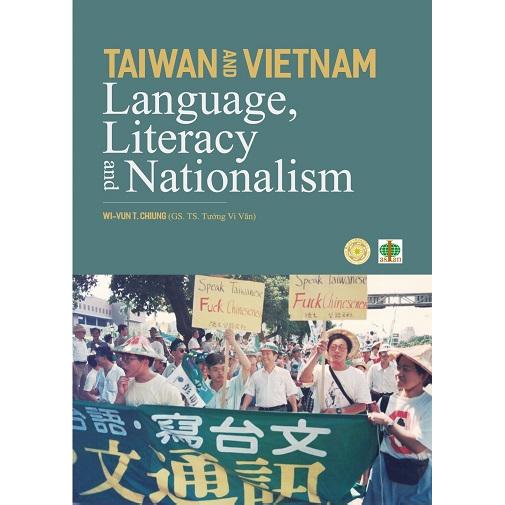
【電子書】Taiwan and Vietnam: language,literacy and nationalism


-
 預計最高可得金幣20點
?
可100%折抵
活動加倍另計 -
HAPPY GO享100累1點 4點抵1元 折抵無上限
-
分類:追蹤? 追蹤分類後,您會在第一時間收到分類新品通知。
- 作者: Wi-vun T. Chiung 追蹤
- 出版社: 亞細亞 追蹤 ? 追蹤出版社後,您會在第一時間收到出版社新書通知。
- 出版日:2020/09/01
-
※ 金石堂電子書怎麼看
活動訊息
6 吋 mooInk Chill 彩色電子書閱讀器 × 金馬63聯名紀念款

第48次中小學生讀物選介

內容簡介
This book provides readers a better understanding of language, literacy, and nationalism in Taiwan and Vietnam.
This book “Taiwan and Vietnam: Language, Literacy and Nationalism” in English is an overall survey of Vietnam and Taiwan from a perspective of comparative studies. In addition, this book also introduces and compares the history of language, orthography and literature in the Hanji cultural sphere, such as Vietnam, Taiwan, Korea and Japan. This book can be considered one of the rare publications introducing the history of language and literature of Taiwan to Vietnamese readers.
This book “Taiwan and Vietnam: Language, Literacy and Nationalism” in English is an overall survey of Vietnam and Taiwan from a perspective of comparative studies. In addition, this book also introduces and compares the history of language, orthography and literature in the Hanji cultural sphere, such as Vietnam, Taiwan, Korea and Japan. This book can be considered one of the rare publications introducing the history of language and literature of Taiwan to Vietnamese readers.
目錄
Foreword 1
Foreword 2
Foreword 3
Preface
01 Features and prospects in comparative studies of Vietnam and Taiwan
02 Language, literacy, and nationalism: Taiwan’s orthographic transition from the perspective of Han sphere
03 Road to orthographic Romanization: Vietnam and Taiwan
04 Sound and writing systems in Taiwanese, Chinese and Vietnamese
05 Learning efficiencies for Han characters and Vietnamese Roman scripts
06 Impact of monolingual policy on language and ethnic identity: a case study of Taiwan
07 Romanization and language planning in Taiwan
08 Pe̍h-ōe-jī as intangible cultural heritage of Taiwan
09 Taiwanese or Southern Min? On the controversy of ethnolinguistic names in Taiwan
10 Language attitudes toward written Taiwanese
11 Development of the Taiwanese proficiency test
序/導讀
【推薦序】
Dr. NGUYỄN Văn Hiệp
Director, Institute of Linguistics
Vietnamese Academy of Social Sciences, VIETNAM
This book of professor Wi-vun CHIUNG could be regarded as a chronicle of Taiwan, the island state that has special relations with Mainland China and has suffered vicissitudes in history, as it used to happen in Korea, Japan and Vietnam.
This book provides many scientific information on Taiwanese language, literature and culture, especially the revitalization and Romanization of Taiwanese language, which is linguistically different from Mandarin Chinese.
The author has portrayed a colorful picture of the island Taiwan. He compared Taiwan with Japan, Korea and Vietnam with regard to the preservation and development of language, literature and culture.
The author has pointed out that the KMT regime considered Taiwan as a Chinese territory divided by geography, so KMT adopted wrong and cruel policy on Taiwan’s languages, literature and culture to prevent Taiwanese people from being identify themselves as Taiwanese.
The author also surveyed the efforts of Taiwanese people to preserve and develop their language and literature in order to retain their national identity. For example, the efforts on Romanization movement, which is still on the half way to success. Or the successful reforms on politics and education in recent decades, which have promoted Taiwan to a modern society with its unique features in the globalization era.
The cultural and economic exchanges between Taiwan and Vietnam have significantly increased in recent decades, this book thus provides valuable references for Taiwanese and Vietnamese people to understand each other better and further to share their experiences in maintaining their own cultural characteristics.
This book also provides valuable knowledge about Taiwanese and Vietnamese from the perspectives of linguistics and orthographies. They are helpful for learning Vietnamese and Taiwanese languages.
Professor Wi-vun CHIUNG is not only a prestigious scholar, but also an enthusiastic patriot. In addition to academic research, he promotes Taiwanese language and literature in order to remain national identity of Taiwan. He also promotes academic exchange between Vietnamese and Taiwanese scholars through many practical events such as international conferences or workshops held by Center for Vietnamese Studies at National Cheng Kung University.
In short, I appreciate and admire what Professor Wi-vun CHIUNG has done so far. I sincerely introduce this book to readers, especially those in Vietnam.
【作者序】
Why Taiwan and Vietnam? Most works of my research are related to comparative studies of Taiwan and Vietnam. Someone may be curious to know why I chose Vietnam to compare with Taiwan?
I was a promoter of Taiwanese languages before I went to graduate school in the USA. I was trying to save the Taiwanese languages which were suppressed by the Chinese monolingual policy of the Chinese KMT regime in Taiwan. I did not know much about Vietnam at that time. My limited impressions about Vietnam were a war and the orthographic transformation from Han characters to Roman scripts. I did not have the chance to get to know the Vietnamese people until I started my graduate studies.
Taiwan and Vietnam share a similar historical experience: that is, both used to be invaded and colonized by the Chinese Empire. As a consequence, Han characters were adopted in Taiwan and Vietnam. Although ancient China had occupied Vietnam for a thousand years and consequently had great influence on the Vietnamese culture, Vietnam has created its own culture with distinct characteristics. How could Vietnam successfully retain their language and national identity? How could Vietnam have so amazingly replaced Han characters with Vietnamese Romanization? In contrast, Roman scripts such as Sinkang Manuscripts or Pe̍h-ōe-jī were the first writing systems that appeared in Taiwan. However, Han characters, which came after Roman scripts, have become the dominant orthography in current Taiwanese society. What are the factors driving different outcomes in Taiwan and Vietnam? Will Taiwan have the potential to revive Taiwanese languages or to replace Han characters with Roman scripts? Those questions stayed in my mind while I was doing my research.
All the papers collected in this book try to answer these questions from different perspectives. The papers were originally presented in conferences, journals or book chapters. They were appropriately revised and updated to make a more consistent and systematic book. I expect this book to provide readers a better understanding of language, literacy and nationalism in Taiwan and Vietnam.
詳細資料
詳細資料
-
- 語言
- 英文
- 裝訂
-
- ISBN
- 9789869888707
- 分級
- 普通級
-
- 頁數
- 280
- 商品規格
- 19*26
-
- 出版地
- 台灣
- 適讀年齡
- 全齡適讀
-
- 注音
- 級別
訂購/退換貨須知
加入金石堂 LINE 官方帳號『完成綁定』,隨時掌握出貨動態:


提醒您!!
金石堂及銀行均不會請您操作ATM! 如接獲電話要求您前往ATM提款機,請不要聽從指示,以免受騙上當!
購買須知:
使用金石堂電子書服務即為同意金石堂電子書服務條款。
電子書分為「金石堂(線上閱讀+APP)」及「Readmoo(兌換碼)」兩種:


- 請至會員中心→電子書服務「我的e書櫃」領取複製『兌換碼』至電子書服務商Readmoo進行兌換。
退換貨須知:
- 因版權保護,您在金石堂所購買的電子書僅能以金石堂專屬的閱讀軟體開啟閱讀,無法以其他閱讀器或直接下載檔案。
- 依據「消費者保護法」第19條及行政院消費者保護處公告之「通訊交易解除權合理例外情事適用準則」,非以有形媒介提供之數位內容或一經提供即為完成之線上服務,經消費者事先同意始提供。(如:電子書、電子雜誌、下載版軟體、虛擬商品…等),不受「網購服務需提供七日鑑賞期」的限制。為維護您的權益,建議您先使用「試閱」功能後再付款購買。






商品評價
評價規範