




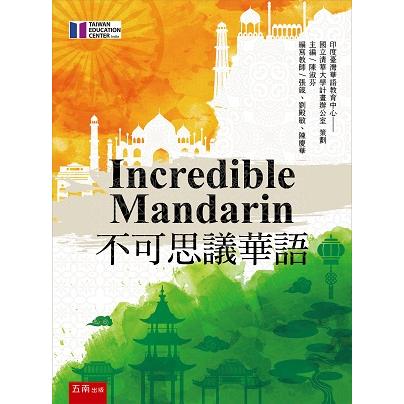
【電子書】Incredible Mandarin不可思議華語




活動訊息
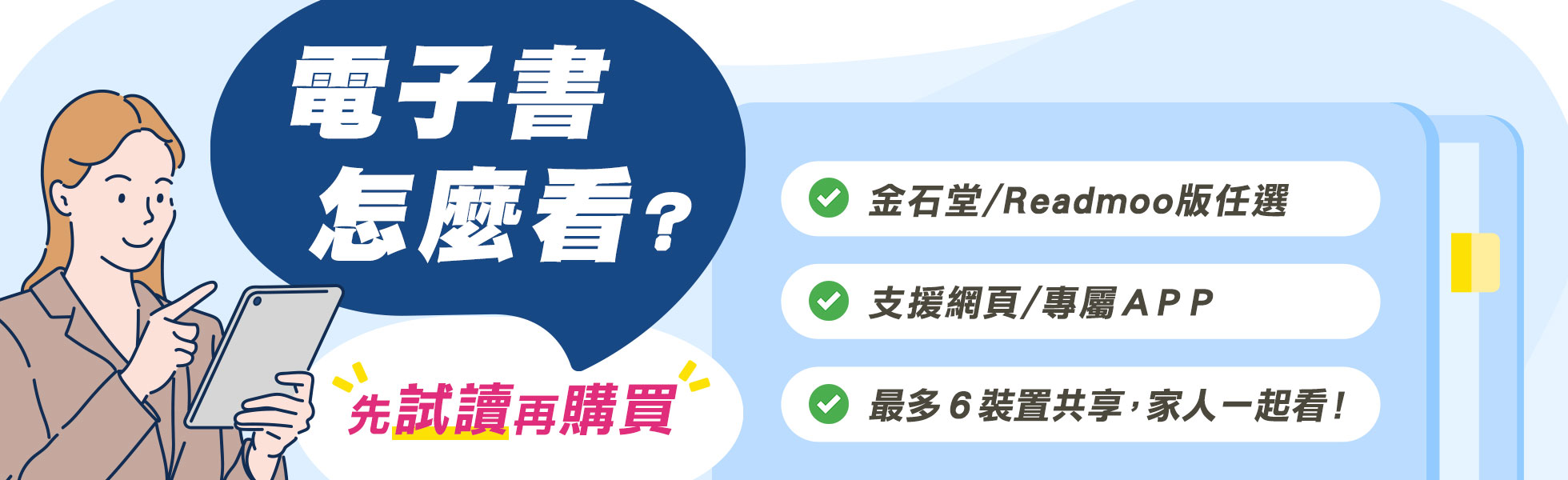
想知道金石堂電子書怎麼用?無論通勤或在家,電腦或手機都能看,輕鬆運用零碎時間,讓閱讀更融入生活。
全館滿$1,200送150點金幣,4月歡慶兒童節,童書、玩具、文具滿1000元再送200點金幣!
內容簡介
鑑於印度大學目前使用的華語教材相當老舊,且與印度的國情與文化有極大差距,故印度臺灣華語教育中心決議為印度學習者編寫一套國別化華語教材。
本書以幽默有趣的故事、文化對比的角度介紹臺灣和印度的文化特色。主要學習對象為在印度大學學習華語第二年、華語程度A2 - B1的印度學生,以文化比較與語言學習為主軸,設計在地化的教材。每一課分為七部分:課程目標及課文屬性、課文對話、短文、生詞、語法、跨文化延伸和語言任務。
希望此書在印度華語教材和臺印文化交流上扮演領頭羊角色,期盼拋磚引玉,能專門為在印度學習華語的學習者編寫更多元、更適性的華語教材。
Given that the Mandarin textbooks currently used by Indian universities are pretty outdated, bearing a large gap with the Indian culture and condition of the nation, TEC has been proactive in advancing pedagogies and teaching materials.
Incredible Mandarin is targeted at students learning Mandarin Chinese for the second year at Indian universities or those with Chinese skills between CEFR A2 and B1 levels. This book is designed with localized content aiming at cultural comparison and language learning for communication. The ten lessons are threaded by an interesting story, introducing cultural highlights of Taiwan and India through cross-culture comparison. Each lesson is divided into seven parts: Lesson Objectives and Topics, Dialogues, Readings, Vocabulary, Grammar, Cross-Cultural Extension, and Language Tasks.
With this book, we have finally started the trial and set foot on the expedition of language education materials for Indian learners. For an even better cross-cultural communication between India and Taiwan, we sincerely hope this textbook would lead more scholars to join us in developing and providing more diverse and adaptive teaching materials for learners in India.
目錄
序一 Preface 1
序二 Preface 2
各課重點 Scope and Sequence
詞類表 Parts of Speech in Chinese
主要人物介紹 Introduction to the Main Characters
Lesson 1 印度我們來了 India, Here We Come!
Lesson 2 接風 Holding a Welcome Reception
Lesson 3 自由行 Self-Organized Tours
Lesson 4 熱鬧的排燈節 Lively Diwali
Lesson 5 去喝喜酒 Going to a Wedding Reception
Lesson 6 古蹟的故事 Stories of Ancient Monuments
Lesson 7 逛逛市集 Going to the Market
Lesson 8 養生的方法 Ways of Keeping Healthy
Lesson 9 伴手禮 Souvenirs
Lesson 10 歡送會 Farewell Dinner
附錄一 生詞索引 中—英
Vocabulary Index (Chinese-English)
附錄二 生詞索引 英—中
Vocabulary Index (English-Chinese)
附錄三 簡體字課文
Text in Simplified Characters
附錄四 跨文化延伸中文版
Cross-Cultural Extension in Chinese
序/導讀
序一 Preface I
In 2009, I was very honored to arrange the former Minister, Dr. Ching-Ji Wu’s visit to India. It was the first time a minister from the Republic of China (Taiwan) visited India.
The former Minister, Dr. Wu and the former Minister of the Ministry of Human Resource Development, India (MHRD) had a meeting. Minister, Mr. Kapil Sibal asked Taiwan to send 10,000 Mandarin Chinese instructors to India. It was then we understood how broad a future Mandarin Chinese language education has in India.
After returning to Taiwan, National Tsing Hua University (NTHU) officially accepted the mission from the Ministry of Education (MOE), Taiwan, to establish Taiwan Education Centers in India (TEC). In the very beginning, I tried to contact sister universities of NTHU in India; however, the negotiation process was very challenging, as most were national institutions and there were no formal diplomatic relations between Taiwan and India. It wasn’t until 2011 that Mr. Rawat, former Representative of India in India-Taipei Association (ITA) then, introduced a private university, “O.P. Jindal Global University”, to establish the first Taiwan Education Center in India, known as TEC-JGU. In addition, it was very lucky that, in Dubai Education Fair, I happened to come across the son of the Founder of Amity University, the largest private university in India. This has led us to set up the second TEC in India, also known as TEC-Amity.
After two TECs in private universities in India have been established, with the help of Prof. T.C.A. Rangachari in Jamia Millia Islamia (JMI), the first TEC in national university was founded in May 2013, also known as TEC-JMI. Professor Rangachari speaks fluent Mandarin Chinese which he acquired in the Republic of China before 1949. Professor Rangachari was the former Indian Ambassador to Germany and France In the same year, 2013, the 4th TEC was established in Indian Institute of Technology Madras (IITM), also known as TEC-IITM. If it wasn’t for the MoU of sister universities signed during the former NTHU President, Dr. Wen-Tsuen Chen’s, visit to India in 2009 this would not have been possible.During 2015 to 2017, NTHU has further established TEC in Jawaharlal Nehru University (JNU), SRM University (Sri Ramaswamy Memorial University, which was renamed as SRM Institute of Science and Technology, SRMIST), and Indian Institute of Technology Bombay (IITB). These three branches namely TEC-JNU, TEC-SRMIST, TECIITB.
Since 2011, one TEC has been established each year on an average (details shown in table 1). Later MOE suggested that we could slow down our pace. Nevertheless, Chitkara University contacted us in 2018, expressing that they would like to support NTHU to set up a TEC in their campus and offered to cover all the expenses required. The 8th TEC was still much supported by MOE in Chitkara University, and hence, TEC-Chitkara was established in 2019. The Ministry of Education altered its previous policy and acceded to NTHU to continue establishing TEC in India. In this regard, the 9th TEC in India in SRM University, Andhra Pradesh, was established, also known as TEC-SRMAP.
The establishment of TEC assists institutions around Taiwan to collaborate with the Indian universities. With the education of Traditional Chinese characters, it was possible to introduce Taiwanese culture to Indian students and helps them to have better understandings of Taiwan. The Indian-Taiwan bilateral collaboration has been fruitful with the partner universities’ support in providing our instructors’ staff quarters and other necessities.
After running TEC for about 5 to 6 years, we came to notice that there are no books from Taiwan in India. For one, the Indian government protects the press an
訂購/退換貨須知
加入金石堂 LINE 官方帳號『完成綁定』,隨時掌握出貨動態:


提醒您!!
金石堂及銀行均不會請您操作ATM! 如接獲電話要求您前往ATM提款機,請不要聽從指示,以免受騙上當!
購買須知:
使用金石堂電子書服務即為同意金石堂電子書服務條款。
電子書分為「金石堂(線上閱讀+APP)」及「Readmoo(兌換碼)」兩種:


- 請至會員中心→電子書服務「我的e書櫃」領取複製『兌換碼』至電子書服務商Readmoo進行兌換。
退換貨須知:
- 因版權保護,您在金石堂所購買的電子書僅能以金石堂專屬的閱讀軟體開啟閱讀,無法以其他閱讀器或直接下載檔案。
- 依據「消費者保護法」第19條及行政院消費者保護處公告之「通訊交易解除權合理例外情事適用準則」,非以有形媒介提供之數位內容或一經提供即為完成之線上服務,經消費者事先同意始提供。(如:電子書、電子雜誌、下載版軟體、虛擬商品…等),不受「網購服務需提供七日鑑賞期」的限制。為維護您的權益,建議您先使用「試閱」功能後再付款購買。






商品評價