





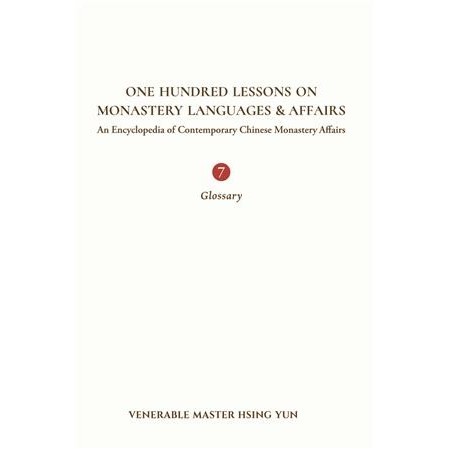
【電子書】One hundred lessons on monastery languages and affairs. vol. 7: glossary



金石堂 電子書
?
-
 預計最高可得金幣5點
?
可100%折抵
預計最高可得金幣5點
?
可100%折抵
活動加倍另計 -
HAPPY GO享100累1點 4點抵1元 折抵無上限
-
分類:電子書>新書搶先看★>綜合書籍>追蹤? 追蹤分類後,您會在第一時間收到分類新品通知。
- 作者: Venerable Master Hsing Yun 星雲大師 追蹤
- 出版日:2025/09/01

活動訊息
Kobo閱讀器77折起,再送購書金最高1000元

文石閱讀器_開學季_選購指定型號即贈專用皮套

2026金石堂暑假漫博〈你好,我吃一點〉第二波

金石堂2026海外優惠:電子書

內容簡介
內容簡介
The transmission of Buddhism to China gave rise to a uniquely rich and systematic monastic tradition. One Hundred Lessons on Monastery Languages & Affairs offers an in-depth exploration of this tradition through six themes: Monastery Systems, Monastic Precepts, Temple Undertakings, Cultivation and Gatherings, Organizational Management, and Spread of Buddhism. Drawing from decades of lived experience, it guides readers through the past, present, and evolving future of Chinese Buddhist monasticism.
目錄
VOLUME 1
MONASTERY SYSTEMS
Table of Contents
About Venerable Master Hsing Yun
Translator’s Introduction
Preface
Lesson One: Types of Buddhist Monasteries
Lesson Two: Monasteries in the Mainland China
Lesson Three: Layout of a Monastery
Lesson Four: The Forty-Eight Positions
Lesson Five: The Meaning of “Unit”
Lesson Six: Monastery Anecdotes
Lesson Seven: Buddhist Titles
Lesson Eight: Monastery Language
Lesson Nine: A Day in Monastery
Lesson Ten: The Four Main Halls
Lesson Eleven: Monastic Quarters Rounds to Notify the Community
Lesson Twelve: Beginning and End of a Term
Lesson Thirteen: Free Incense Period and Day Off
Lesson Fourteen: Living Regulations
Lesson Fifteen: Removal from Monastery and Leaving Without Notification
Lesson Sixteen: Special Questions
Lesson Seventeen: Extraordinary Figures
Lesson Eighteen: Monastic Property
Index
推薦序/前言
PREFACE
Buddhist Knowledge and Wisdom
Looking back on more than sixty years of monastic life, I remember traveling across China in my youth to study at various renowned monasteries. I studied the Vinaya at Qixia Vinaya College and the Precept Hall at Mount Baohua, pursued doctrinal studies at Jiaoshan Buddhist College, and resided in Chan monasteries such as Jinshan and Tianning. Whether in Vinaya, doctrinal, or Chan traditions, I diligently followed the assembly in attending Dharma services, performing communal labor, participating in Chan meditation retreats during spring and summer, and Buddha-name recitation retreats during autumn and winter. I undertook every task—serving meals, cooking, tending shrines, managing water, cutting firewood in the mountains, and drawing water from the river. During this time, I laid a solid foundation in the comportment, mindset, practice, and character required of a monastic.
As time went on, the traditions, systems, and regulations of the various schools gradually took root and blended within my heart. I believe that these invaluable experiences of traveling and learning should be passed on to my disciples, so they may understand the essential qualities that a monastic must embody, and what mindset and capabilities are needed to stand firmly in today’s society. Moreover, I hope to offer this knowledge to the wider public, so that all may gain a proper understanding of the knowledge and wisdom of the Buddhist tradition.
With this aspiration in mind, over the years I have taught One Hundred Lessons on Monastery Languages and Affairs not only at Buddhist colleges, but also as part of the “Light Transmission College” curriculum for Fo Guang Shan disciples. I also delivered these teachings during the Triple Platform Full Ordination Ceremonies held at Fo Guang Shan and Hsi Lai Temple in the United States. However, the content was never formally compiled and published. It was not until 2009, when conditions had ripened, that I spent three months recording a 104-episode video series of One Hundred Lessons on Monastery Languages and Affairs, produced by the Fo Guang Shan Television Center. Each episode focuses on a specific topic and is presented in a Q&A format, with Venerable Tzu Hui posing the questions and myself providing the explanations.
The content of these lessons can be broadly categorized into six areas: administrative systems, etiquette and general knowledge, cultivation of monastic character, various forms of practice, Dharma propagation and benefiting sentient beings, and Buddhist cuisine. Included are my observations and experiences from studying in various monasteries, my first-hand encounters within the Buddhist community, and my aspirations for the future development of Buddhism. I hope this work may serve as a reference for teaching and guiding disciples, leading temples, establishing monastic communities, propagating the Dharma, and deepening understanding of the Buddhist tradition.
In summary, One Hundred Lessons on Monastery Languages and Affairs possesses four main features:
1. Explanations of monastic implements and their usage
2. Introductions to Buddhist rituals and ceremonial practices
3. Fundamental knowledge for approaching and understanding the Buddhist community
4. Insights into the culture and dissemination of Buddhism
In addition, each lesson is appropriately supplemented with images and video to enhance its vividness and accessibility. For example, in the segments on Buddhist chanting, Venerable Tzu Jung leads the Fo Guang Shan monastics in actual recitation. In Buddhist cuisine, Shigu Hsiao Pi-Hsia demonstrates the preparation of noodles and rice. Furthermore, topics covering eminent masters of various schools, renowned monasteries, and commonly used Dharma instruments are accompanied by illustrative visuals. These materials are intended to help the audience gain a clear understanding of Buddhist terminology and deepen their comprehension of the Dharma.
Since the release of the One Hundred Lessons on Monastery Languages and Affairs video series, it has received warm support and valuable feedback from viewers. To better meet the needs of a wider readership, we organized, supplemented, and refined the recorded content, adding explanatory notes on key Buddhist terms. This compilation has now been published into a book series, allowing readers to gain a comprehensive understanding of both the daily life within the monastery and the lifelong journey of a monastic.
Now, as the One Hundred Lessons on Monastery Languages & Affairs book series is about to be published by the Fo Guang Shan Board of Directors, I offer this brief account of its origins and development. This serves as my preface.
Hsing Yun
March 2012
The transmission of Buddhism to China gave rise to a uniquely rich and systematic monastic tradition. One Hundred Lessons on Monastery Languages & Affairs offers an in-depth exploration of this tradition through six themes: Monastery Systems, Monastic Precepts, Temple Undertakings, Cultivation and Gatherings, Organizational Management, and Spread of Buddhism. Drawing from decades of lived experience, it guides readers through the past, present, and evolving future of Chinese Buddhist monasticism.
目錄
VOLUME 1
MONASTERY SYSTEMS
Table of Contents
About Venerable Master Hsing Yun
Translator’s Introduction
Preface
Lesson One: Types of Buddhist Monasteries
Lesson Two: Monasteries in the Mainland China
Lesson Three: Layout of a Monastery
Lesson Four: The Forty-Eight Positions
Lesson Five: The Meaning of “Unit”
Lesson Six: Monastery Anecdotes
Lesson Seven: Buddhist Titles
Lesson Eight: Monastery Language
Lesson Nine: A Day in Monastery
Lesson Ten: The Four Main Halls
Lesson Eleven: Monastic Quarters Rounds to Notify the Community
Lesson Twelve: Beginning and End of a Term
Lesson Thirteen: Free Incense Period and Day Off
Lesson Fourteen: Living Regulations
Lesson Fifteen: Removal from Monastery and Leaving Without Notification
Lesson Sixteen: Special Questions
Lesson Seventeen: Extraordinary Figures
Lesson Eighteen: Monastic Property
Index
推薦序/前言
PREFACE
Buddhist Knowledge and Wisdom
Looking back on more than sixty years of monastic life, I remember traveling across China in my youth to study at various renowned monasteries. I studied the Vinaya at Qixia Vinaya College and the Precept Hall at Mount Baohua, pursued doctrinal studies at Jiaoshan Buddhist College, and resided in Chan monasteries such as Jinshan and Tianning. Whether in Vinaya, doctrinal, or Chan traditions, I diligently followed the assembly in attending Dharma services, performing communal labor, participating in Chan meditation retreats during spring and summer, and Buddha-name recitation retreats during autumn and winter. I undertook every task—serving meals, cooking, tending shrines, managing water, cutting firewood in the mountains, and drawing water from the river. During this time, I laid a solid foundation in the comportment, mindset, practice, and character required of a monastic.
As time went on, the traditions, systems, and regulations of the various schools gradually took root and blended within my heart. I believe that these invaluable experiences of traveling and learning should be passed on to my disciples, so they may understand the essential qualities that a monastic must embody, and what mindset and capabilities are needed to stand firmly in today’s society. Moreover, I hope to offer this knowledge to the wider public, so that all may gain a proper understanding of the knowledge and wisdom of the Buddhist tradition.
With this aspiration in mind, over the years I have taught One Hundred Lessons on Monastery Languages and Affairs not only at Buddhist colleges, but also as part of the “Light Transmission College” curriculum for Fo Guang Shan disciples. I also delivered these teachings during the Triple Platform Full Ordination Ceremonies held at Fo Guang Shan and Hsi Lai Temple in the United States. However, the content was never formally compiled and published. It was not until 2009, when conditions had ripened, that I spent three months recording a 104-episode video series of One Hundred Lessons on Monastery Languages and Affairs, produced by the Fo Guang Shan Television Center. Each episode focuses on a specific topic and is presented in a Q&A format, with Venerable Tzu Hui posing the questions and myself providing the explanations.
The content of these lessons can be broadly categorized into six areas: administrative systems, etiquette and general knowledge, cultivation of monastic character, various forms of practice, Dharma propagation and benefiting sentient beings, and Buddhist cuisine. Included are my observations and experiences from studying in various monasteries, my first-hand encounters within the Buddhist community, and my aspirations for the future development of Buddhism. I hope this work may serve as a reference for teaching and guiding disciples, leading temples, establishing monastic communities, propagating the Dharma, and deepening understanding of the Buddhist tradition.
In summary, One Hundred Lessons on Monastery Languages and Affairs possesses four main features:
1. Explanations of monastic implements and their usage
2. Introductions to Buddhist rituals and ceremonial practices
3. Fundamental knowledge for approaching and understanding the Buddhist community
4. Insights into the culture and dissemination of Buddhism
In addition, each lesson is appropriately supplemented with images and video to enhance its vividness and accessibility. For example, in the segments on Buddhist chanting, Venerable Tzu Jung leads the Fo Guang Shan monastics in actual recitation. In Buddhist cuisine, Shigu Hsiao Pi-Hsia demonstrates the preparation of noodles and rice. Furthermore, topics covering eminent masters of various schools, renowned monasteries, and commonly used Dharma instruments are accompanied by illustrative visuals. These materials are intended to help the audience gain a clear understanding of Buddhist terminology and deepen their comprehension of the Dharma.
Since the release of the One Hundred Lessons on Monastery Languages and Affairs video series, it has received warm support and valuable feedback from viewers. To better meet the needs of a wider readership, we organized, supplemented, and refined the recorded content, adding explanatory notes on key Buddhist terms. This compilation has now been published into a book series, allowing readers to gain a comprehensive understanding of both the daily life within the monastery and the lifelong journey of a monastic.
Now, as the One Hundred Lessons on Monastery Languages & Affairs book series is about to be published by the Fo Guang Shan Board of Directors, I offer this brief account of its origins and development. This serves as my preface.
Hsing Yun
March 2012
訂購/退換貨須知
加入金石堂 LINE 官方帳號『完成綁定』,隨時掌握出貨動態:


提醒您!!
金石堂及銀行均不會請您操作ATM! 如接獲電話要求您前往ATM提款機,請不要聽從指示,以免受騙上當!
購買須知:
使用金石堂電子書服務即為同意金石堂電子書服務條款。
電子書分為「金石堂(線上閱讀+APP)」及「Readmoo(兌換碼)」兩種:


- 請至會員中心→電子書服務「我的e書櫃」領取複製『兌換碼』至電子書服務商Readmoo進行兌換。
退換貨須知:
- 因版權保護,您在金石堂所購買的電子書僅能以金石堂專屬的閱讀軟體開啟閱讀,無法以其他閱讀器或直接下載檔案。
- 依據「消費者保護法」第19條及行政院消費者保護處公告之「通訊交易解除權合理例外情事適用準則」,非以有形媒介提供之數位內容或一經提供即為完成之線上服務,經消費者事先同意始提供。(如:電子書、電子雜誌、下載版軟體、虛擬商品…等),不受「網購服務需提供七日鑑賞期」的限制。為維護您的權益,建議您先使用「試閱」功能後再付款購買。





商品評價