




神秘的亨特堡:第一部(國際英文版)
The Mysterious Hunter Castle: Part One






活動訊息
東野圭吾紀念作品展

春光x奇幻基地|全書系展

閱讀漫遊錄-2026上半年暢銷榜

飢餓遊戲前傳贈早優券

教場電影版

十字殺手【艾迪.弗林系列 前傳】

世界上最透明的故事【夏季限量版】:全新封面×透明書衣×燙銀加工,售完即絕版

內容簡介
The Mysterious Hunter Castle is a sweeping techno-thriller infused with moral philosophy, geopolitical tension, and spiritual undertones. Blending high-stakes action with profound ethical inquiry, it challenges readers to reconsider the nature of power, accountability, and redemption in a fractured world.
The sequel to this story, Part 2 in the Hunter Castle Sseries is forthcoming.
The sequel to this story, Part 2 in the Hunter Castle Sseries
名人推薦
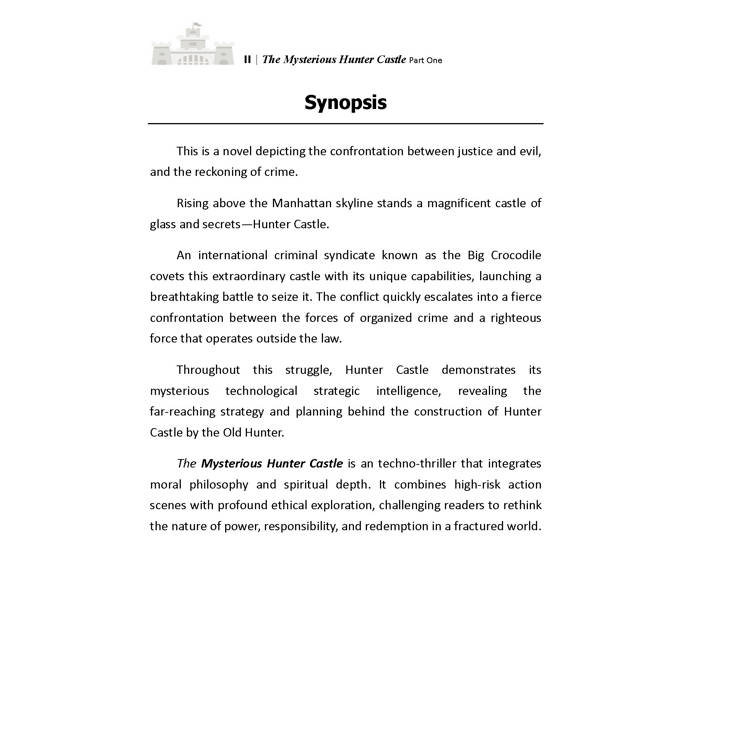
☆Synopsis☆
The Mysterious Hunter Castle is a sweeping techno-thriller infused with moral philosophy, geopolitical tension, and spiritual undertones. Blending high-stakes action with profound ethical inquiry, it challenges readers to reconsider the nature of power, accountability, and redemption in a fractured world.
In the end, the loudest victory may come not from force—
but from silence.
Synopsis of the next volume in the Hunter Castle series, The Legend of Old Ginger:
A hard drive left behind in Hunter castle by a Chinese businessman has a dark backstory, reigniting a fierce battle. Led by the wise Old Ginger, a group of righteous individuals gather at Hunter Castle, using ingenious mechanisms and clever tactics to outwit the villains and ultimately bring the highly intelligent culprit to his death. This book is forthcoming.
The Mysterious Hunter Castle is a sweeping techno-thriller infused with moral philosophy, geopolitical tension, and spiritual undertones. Blending high-stakes action with profound ethical inquiry, it challenges readers to reconsider the nature of power, accountability, and redemption in a fractured world.
In the end, the loudest victory may come not from force—
but from silence.
Synopsis of the next volume in the Hunter Castle series, The Legend of Old Ginger:
A hard drive left behind in Hunter castle by a Chinese businessman has a dark backstory, reigniting a fierce battle. Led by the wise Old Ginger, a group of righteous individuals gather at Hunter Castle, using ingenious mechanisms and clever tactics to outwit the villains and ultimately bring the highly intelligent culprit to his death. This book is forthcoming.
目錄
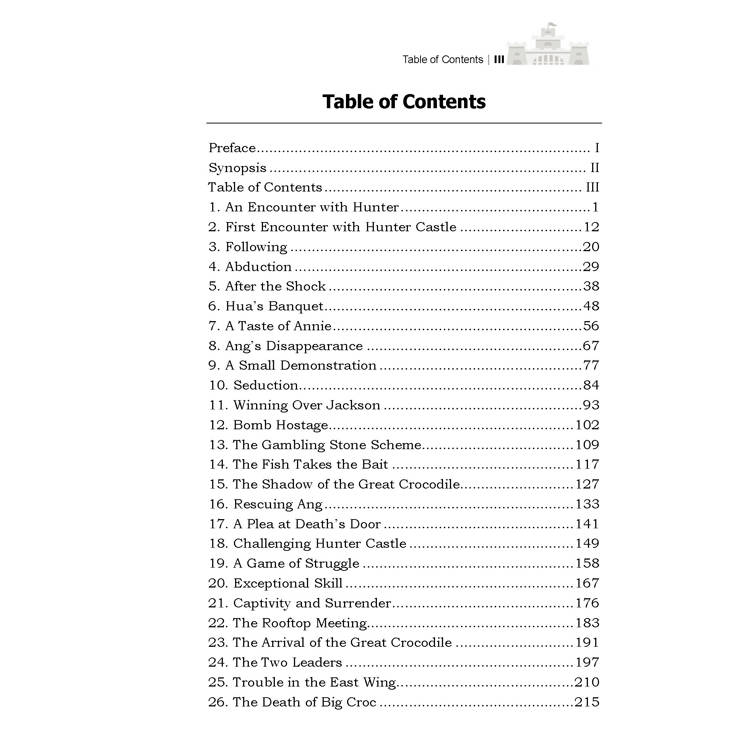
Table of Contents
Preface
Synopsis
1. An Encounter with Hunter
2. First Encounter with Hunter Castle
3. Following
4. Abduction
5. After the Shock
6. Hua’s Banquet
7. A Taste of Annie
8. Ang’s Disappearance
9. A Small Demonstration
10. Seduction
11. Winning Over Jackson
12. Bomb Hostage
13. The Gambling Stone Scheme
14. The Fish Takes the Bait
15. The Shadow of the Great Crocodile
16. Rescuing Ang
17. A Plea at Death’s Door
18. Challenging Hunter Castle
19. A Game of Struggle
20. Exceptional Skill
21. Captivity and Surrender
22. The Rooftop Meeting
23. The Arrival of the Great Crocodile
24. The Two Leaders
25. Trouble in the East Wing
26. The Death of Big Croc
27. Demons Dancing in the Gutter
28. The Assassination Attempt
29. The Corrupt Officer, David
30. Godi’s Mission
31. The Hip-Hop Journey
32. Guy’s Hint
33. A Heavy Revelation
34. Officer Bank
35. The Dwarf Infiltration
36. Fighting the Thugs
37. Battle with the Mob
38. Bank Reveals His True Colors
39. Flash-Bang Collapse
40. Godi Persuades Them to Surrender
41. Ang Stabs Black Fiend
42. Melee in the Central Hall
43. The Missile Threat
44. The Armored Troops
45. The Fisherman Profits
46. Annie the Guide
47. Annie Revealed
48. The Global Tribunal
49. Robertson Frustrated
50. The First Battle Ends
Afterward
Preface
Synopsis
1. An Encounter with Hunter
2. First Encounter with Hunter Castle
3. Following
4. Abduction
5. After the Shock
6. Hua’s Banquet
7. A Taste of Annie
8. Ang’s Disappearance
9. A Small Demonstration
10. Seduction
11. Winning Over Jackson
12. Bomb Hostage
13. The Gambling Stone Scheme
14. The Fish Takes the Bait
15. The Shadow of the Great Crocodile
16. Rescuing Ang
17. A Plea at Death’s Door
18. Challenging Hunter Castle
19. A Game of Struggle
20. Exceptional Skill
21. Captivity and Surrender
22. The Rooftop Meeting
23. The Arrival of the Great Crocodile
24. The Two Leaders
25. Trouble in the East Wing
26. The Death of Big Croc
27. Demons Dancing in the Gutter
28. The Assassination Attempt
29. The Corrupt Officer, David
30. Godi’s Mission
31. The Hip-Hop Journey
32. Guy’s Hint
33. A Heavy Revelation
34. Officer Bank
35. The Dwarf Infiltration
36. Fighting the Thugs
37. Battle with the Mob
38. Bank Reveals His True Colors
39. Flash-Bang Collapse
40. Godi Persuades Them to Surrender
41. Ang Stabs Black Fiend
42. Melee in the Central Hall
43. The Missile Threat
44. The Armored Troops
45. The Fisherman Profits
46. Annie the Guide
47. Annie Revealed
48. The Global Tribunal
49. Robertson Frustrated
50. The First Battle Ends
Afterward
序/導讀
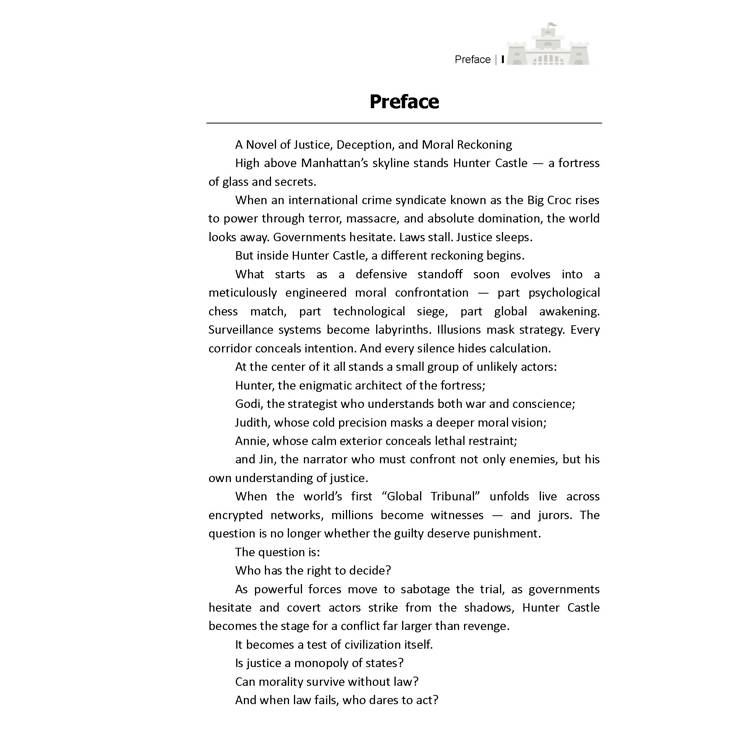
☆Preface☆
A Novel of Justice, Deception, and Moral Reckoning
High above Manhattan’s skyline stands Hunter Castle — a fortress of glass and secrets.
When an international crime syndicate known as the Big Croc rises to power through terror, massacre, and absolute domination, the world looks away. Governments hesitate. Laws stall. Justice sleeps.
But inside Hunter Castle, a different reckoning begins.
What starts as a defensive standoff soon evolves into a meticulously engineered moral confrontation — part psychological chess match, part technological siege, part global awakening. Surveillance systems become labyrinths. Illusions mask strategy. Every corridor conceals intention. And every silence hides calculation.
At the center of it all stands a small group of unlikely actors:
Hunter, the enigmatic architect of the fortress;
Godi, the strategist who understands both war and conscience;
Judith, whose cold precision masks a deeper moral vision;
Annie, whose calm exterior conceals lethal restraint;
and Jin, the narrator who must confront not only enemies, but his own understanding of justice.
When the world’s first “Global Tribunal” unfolds live across encrypted networks, millions become witnesses — and jurors. The question is no longer whether the guilty deserve punishment.
The question is:
Who has the right to decide?
As powerful forces move to sabotage the trial, as governments hesitate and covert actors strike from the shadows, Hunter Castle becomes the stage for a conflict far larger than revenge.
It becomes a test of civilization itself.
Is justice a monopoly of states?
Can morality survive without law?
And when law fails, who dares to act?
A Novel of Justice, Deception, and Moral Reckoning
High above Manhattan’s skyline stands Hunter Castle — a fortress of glass and secrets.
When an international crime syndicate known as the Big Croc rises to power through terror, massacre, and absolute domination, the world looks away. Governments hesitate. Laws stall. Justice sleeps.
But inside Hunter Castle, a different reckoning begins.
What starts as a defensive standoff soon evolves into a meticulously engineered moral confrontation — part psychological chess match, part technological siege, part global awakening. Surveillance systems become labyrinths. Illusions mask strategy. Every corridor conceals intention. And every silence hides calculation.
At the center of it all stands a small group of unlikely actors:
Hunter, the enigmatic architect of the fortress;
Godi, the strategist who understands both war and conscience;
Judith, whose cold precision masks a deeper moral vision;
Annie, whose calm exterior conceals lethal restraint;
and Jin, the narrator who must confront not only enemies, but his own understanding of justice.
When the world’s first “Global Tribunal” unfolds live across encrypted networks, millions become witnesses — and jurors. The question is no longer whether the guilty deserve punishment.
The question is:
Who has the right to decide?
As powerful forces move to sabotage the trial, as governments hesitate and covert actors strike from the shadows, Hunter Castle becomes the stage for a conflict far larger than revenge.
It becomes a test of civilization itself.
Is justice a monopoly of states?
Can morality survive without law?
And when law fails, who dares to act?
試閱
1. An Encounter with Hunter
The night was hazy.
A thin mist hung over the streets of Manhattan, softening the neon lights into blurred halos. Music throbbed somewhere in the distance, mixed with laughter, engines, and the restless pulse of a city that refused to sleep.
On a narrow street just off Broadway, a group of young Black men stood in a loose circle, their posture relaxed but their eyes sharp—focused on a single figure at the center.
That figure was a Chinese man.
It was me.
The incident happened five years after I immigrated to the United States.
At the time, I made my living drawing portraits on the street.
In Times Square, disputes over territory and customers were part of the ecosystem. Artists claimed their spots, protected their clients, and learned quickly when to argue—and when not to.
I had always followed the rules.
Avoid confrontation.
Keep a low profile.
And most importantly—never reveal what I could actually do.
Yet within a single month, I broke that rule twice.
The first time was with Black men.
The second, with White men.
Ironically, neither involved my fellow Chinese street artists, who were usually my competitors.
It was late—technically early morning.
Manhattan, soaked in alcohol and electric light, was still alive, still celebrating.
A Chinese painter was arguing loudly with several young Black men. The voices were rising, sharp and heated, balanced on the edge of violence.
I had been walking past.
I stopped.
Then I stepped in.
Around us, other Chinese painters quietly slipped away. No one wanted to be caught in what was about to happen.
I moved between the two sides.
The dispute itself was simple.
One of the men refused to pay for his portrait, claiming it “didn’t look like him.” At the same time, he insisted he had “portrait rights,” and therefore deserved to keep the drawing for free.
Absurd—but not unusual.
There were no police nearby.
The men were drunk. Loud. Confident.
And there were several of them.
I asked my friend to hand me the framed portrait.
Holding it up with both hands, I faced them.
And I began to negotiate.
It was not an equal negotiation.
Several intoxicated young men—
against one unaccompanied stranger.
I raised one hand slightly, signaling for quiet.
They didn’t fully stop talking, but their attention shifted. That was enough.
“I’ll make you a deal,” I said.
They paused.
“I’ll wrestle one of you.”
A brief silence. Then a ripple of laughter.
“If I lose,” I continued, “you keep the portrait. No charge.”
The laughter grew louder.
“If I win—”
I didn’t get to finish.
They were already clapping, shouting, circling around me as if the confrontation had turned into entertainment.
Good.
That was exactly what I wanted.
They formed a ring.
I stood in the center, both hands still holding the portrait up.
A tall man stepped forward.
He wasn’t bulky, but he had long arms and an easy reach. He studied me carefully, moving in slow, cautious steps.
My posture confused him.
Both hands raised.
Holding a painting.
No guard.
No stance.
No intention to fight—at least, none that he could recognize.
That bothered him.
And when a man feels his pride questioned, he becomes predictable.
He stepped closer.
Reached out.
Hesitated.
Then reached again.
That was the moment.
I shifted my weight slightly and dropped my center of gravity.
My foot tapped lightly against his front ankle.
A reflex. He pulled it back.
And in that instant, his balance shifted to the other leg.
I struck that one.
Clean.
Precise.
No wasted movement.
He lost his footing immediately.
His body tilted—then dropped hard onto the pavement.
The fall wasn’t dangerous.
But it was humiliating.
By the time he hit the ground, I was already back in my original position.
Both hands raised.
Holding the portrait.
Perfectly still.
The laughter stopped.
Just like that.
Silence settled over the circle.
A few seconds passed.
Then, without a word, they dispersed.
That was my first physical confrontation in America.
Brief.
Controlled.
Efficient.
But it marked a turning point in my life.
Because someone had been watching.
His name was Mike Hunter.
The night was hazy.
A thin mist hung over the streets of Manhattan, softening the neon lights into blurred halos. Music throbbed somewhere in the distance, mixed with laughter, engines, and the restless pulse of a city that refused to sleep.
On a narrow street just off Broadway, a group of young Black men stood in a loose circle, their posture relaxed but their eyes sharp—focused on a single figure at the center.
That figure was a Chinese man.
It was me.
The incident happened five years after I immigrated to the United States.
At the time, I made my living drawing portraits on the street.
In Times Square, disputes over territory and customers were part of the ecosystem. Artists claimed their spots, protected their clients, and learned quickly when to argue—and when not to.
I had always followed the rules.
Avoid confrontation.
Keep a low profile.
And most importantly—never reveal what I could actually do.
Yet within a single month, I broke that rule twice.
The first time was with Black men.
The second, with White men.
Ironically, neither involved my fellow Chinese street artists, who were usually my competitors.
It was late—technically early morning.
Manhattan, soaked in alcohol and electric light, was still alive, still celebrating.
A Chinese painter was arguing loudly with several young Black men. The voices were rising, sharp and heated, balanced on the edge of violence.
I had been walking past.
I stopped.
Then I stepped in.
Around us, other Chinese painters quietly slipped away. No one wanted to be caught in what was about to happen.
I moved between the two sides.
The dispute itself was simple.
One of the men refused to pay for his portrait, claiming it “didn’t look like him.” At the same time, he insisted he had “portrait rights,” and therefore deserved to keep the drawing for free.
Absurd—but not unusual.
There were no police nearby.
The men were drunk. Loud. Confident.
And there were several of them.
I asked my friend to hand me the framed portrait.
Holding it up with both hands, I faced them.
And I began to negotiate.
It was not an equal negotiation.
Several intoxicated young men—
against one unaccompanied stranger.
I raised one hand slightly, signaling for quiet.
They didn’t fully stop talking, but their attention shifted. That was enough.
“I’ll make you a deal,” I said.
They paused.
“I’ll wrestle one of you.”
A brief silence. Then a ripple of laughter.
“If I lose,” I continued, “you keep the portrait. No charge.”
The laughter grew louder.
“If I win—”
I didn’t get to finish.
They were already clapping, shouting, circling around me as if the confrontation had turned into entertainment.
Good.
That was exactly what I wanted.
They formed a ring.
I stood in the center, both hands still holding the portrait up.
A tall man stepped forward.
He wasn’t bulky, but he had long arms and an easy reach. He studied me carefully, moving in slow, cautious steps.
My posture confused him.
Both hands raised.
Holding a painting.
No guard.
No stance.
No intention to fight—at least, none that he could recognize.
That bothered him.
And when a man feels his pride questioned, he becomes predictable.
He stepped closer.
Reached out.
Hesitated.
Then reached again.
That was the moment.
I shifted my weight slightly and dropped my center of gravity.
My foot tapped lightly against his front ankle.
A reflex. He pulled it back.
And in that instant, his balance shifted to the other leg.
I struck that one.
Clean.
Precise.
No wasted movement.
He lost his footing immediately.
His body tilted—then dropped hard onto the pavement.
The fall wasn’t dangerous.
But it was humiliating.
By the time he hit the ground, I was already back in my original position.
Both hands raised.
Holding the portrait.
Perfectly still.
The laughter stopped.
Just like that.
Silence settled over the circle.
A few seconds passed.
Then, without a word, they dispersed.
That was my first physical confrontation in America.
Brief.
Controlled.
Efficient.
But it marked a turning point in my life.
Because someone had been watching.
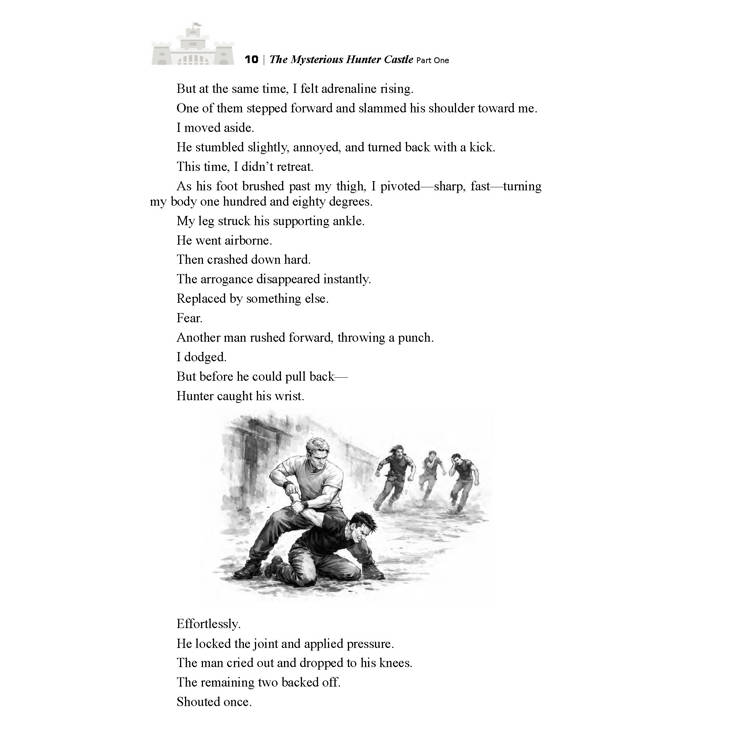
His name was Mike Hunter.
配送方式
-
台灣
- 國內宅配:本島、離島
-
到店取貨:
 不限金額免運費



-
海外
- 國際快遞:全球
-
港澳店取:


訂購/退換貨須知
加入金石堂 LINE 官方帳號『完成綁定』,隨時掌握出貨動態:


提醒您!!
金石堂及銀行均不會請您操作ATM! 如接獲電話要求您前往ATM提款機,請不要聽從指示,以免受騙上當!
退換貨須知:
**提醒您,鑑賞期不等於試用期,退回商品須為全新狀態**
-
依據「消費者保護法」第19條及行政院消費者保護處公告之「通訊交易解除權合理例外情事適用準則」,以下商品購買後,除商品本身有瑕疵外,將不提供7天的猶豫期:
- 易於腐敗、保存期限較短或解約時即將逾期。(如:生鮮食品)
- 依消費者要求所為之客製化給付。(客製化商品)
- 報紙、期刊或雜誌。(含MOOK、外文雜誌)
- 經消費者拆封之影音商品或電腦軟體。
- 非以有形媒介提供之數位內容或一經提供即為完成之線上服務,經消費者事先同意始提供。(如:電子書、電子雜誌、下載版軟體、虛擬商品…等)
- 已拆封之個人衛生用品。(如:內衣褲、刮鬍刀、除毛刀…等)
- 若非上列種類商品,均享有到貨7天的猶豫期(含例假日)。
- 辦理退換貨時,商品(組合商品恕無法接受單獨退貨)必須是您收到商品時的原始狀態(包含商品本體、配件、贈品、保證書、所有附隨資料文件及原廠內外包裝…等),請勿直接使用原廠包裝寄送,或於原廠包裝上黏貼紙張或書寫文字。
- 退回商品若無法回復原狀,將請您負擔回復原狀所需費用,嚴重時將影響您的退貨權益。



商品評價